
The term “Ruse de guerre” is described as “sailing under false colors”. It is an age-old naval tactic that has been used by many nations for centuries. The Barbary pirates menaced shipping with it for years. In 1670, the HMS Kingfisher employed the element of disguise to overwhelm the enemy at sea.
The French used disguised brigs during the French Revolutionary War. In the early days, the tactic disguised sailing ships. In more recent times, countries like Iran, Israel, Turkey, Russia and China are putting highly sophisticated weapons in containers on disguised merchant ships.
During the First World War, the British and the Germans used the tactic. By World War II, the Imperial Japanese Navy and the United States Navy were using disguised ships to surprise and conquer enemy ships and submarines.
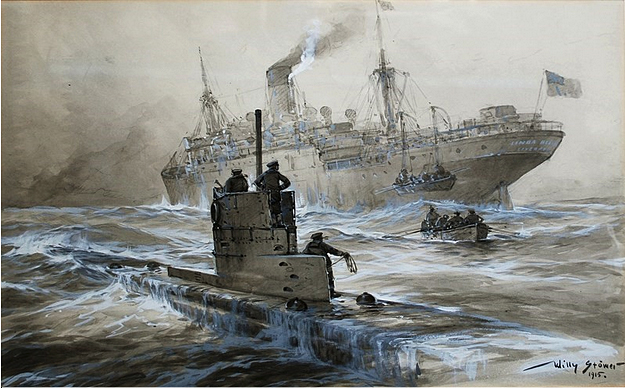
It is interesting to note how careful naval ship commanders were to raise their true colors before attacking an enemy ship. According to international maritime law, ships were allowed to disguise themselves as long as they raised their true colors before firing commenced.
By 1915, during World War I, German U-boats were taking a tremendous toll on vitally needed supply ships. Under the guidance of Vice Commander Lewis Bailey, a solution was undertaken with the advent of Q-ships. The ships were created at the port of Queenstown in Ireland, hence the code name Q-ships. Essentially, a Q-ship would typically be old tramp steamers, unarmed merchant ships, cargo ships, or old fishing vessels that looked harmless but were fitted with powerful deck guns that could sink a submarine at close enough range.
The Germans were running short of expensive torpedoes, so U-boat captains were ordered to conserve torpedoes by surfacing and using deck guns to destroy harmless merchant ships. The tactic was that the Q-ship was to look harmless until the subs were within range of the guns to convince weary boat captains that they had come upon a helpless ship. Once a submarine was sighted, Q-ship crews would stage a panic party with crew members dressed in civilian clothing running around the deck and even jumping overboard in what appeared to be a desperate panic. Then, when the U-boat captain was convinced the ship was no threat, he would surface and move closer to the Q-ship and proceed to sink it. Then, once the U-boat was within range, the Q-ship crews would uncover the hidden deck guns and open fire on the unsuspecting submarine, but not before raising their true colors. At close range, the sub easily became vulnerable to the firepower of the Q-ships’ guns. By 1917, the Germans realized why they were losing many subs to Q-ships, so they changed their approach protocol to what appeared to be innocent, harmless ships. After World War I, despite the success, many military experts concluded the Q-ships were overrated, where actually not the success many thought they were.
During World War II, the idea of using decoy vessels was used extensively by the German Navy. They employed 13 Q-ships. The German ship Atlantic sank ships with a total tonnage of 145,960 tons. A German Q-ship sank the British submarine HMS Tarpon.
The Japanese Navy was not as successful with their Q-ship Delhi-Maru. Accompanied by the submarine chaser Ch-50 and the net layer Tatu-Maru, were spotted by the submarine USS Swordfish which blasted her with three torpedoes that found the mark and sent the Tatu Maru to a watery grave.
The Royal Navy employed nine Q-ships with limited success. The HMS Prunella and HMS Edgehill were both sunk by unknown submarines. Their loss shocked the Royal Navy commanders, prompting them to terminate the British use of Q-ships. During the Falklands War in 1982, the British used the concept once again when they converted a merchant ship, the Atlantic Conveyor, to transport Chinook helicopters and Harrier/Sea jump jets to the South Atlantic. They used shipping containers to provide shelter for the aircraft.
In modern times, the Chinese have adapted the basic concept of the Q-ship to massive container ships, where instead of deck guns, missile-firing weapons are hidden in containers, making them undefinable until ready to attack. The missile systems are also capable of staging an air attack as well. For example, the Zhong Da 79 is a 300-foot cargo ship built in China. In 2025, she was converted to a Q-ship at a shipyard in Longhai. Ordinarily-looking cargo containers were fitted to her deck. The containers are marked on the top left with a large logo text in the center of each container. Translated from Chinese, they read “The Chinese nations” maritime rejuvenation and the three-dimensional maritime community plan.” And “Containerized weapon module development kit.” Toward the center, the ship is fitted with 24 UCAVs (An Unmanned Combat Aerial Vehicle (UCAV), or combat drones, which are reusable, unmanned aircraft that carry, deliver, and guide weapon systems like air-to-surface missiles and precision-guided bombs. Unlike surveillance drones, UCAVs are designed for offensive operations—specifically drone strikes, suppressing air defenses, and targeting key assets from a distance, otherwise known as drones. These are the typical fold-down type designed to fit inside the container. The missile system appears to be the same as the missile system installed on Chinese Navy destroyers. The SAM missiles also resemble a Russian missile system. There are two large radar systems on two containers providing radar coverage that might easily be used in military confrontations, in addition to the containers in the forward section of the ship, which contain drone launching systems. They are designed to conceal the drone and weapons so that the ship will look like an ordinary container ship, yet at a moment’s notice, can launch its deadly arsenal of weapons systems. The success of this use of container ships for concealing weapons has opened up a whole new interest in the age-old concept of the “Ruse de guerre”.
Other countries have joined in the use of hidden drones. The Russian ship Klub and the Turkish ship Kara Atmaca have utilized containers to install drones on otherwise harmless-looking merchant ships.
While the weapons have changed and the methods of concealing those weapons have changed, the concept of the old Q-ship believed to have been used by the Vikings is new again.