I became interested in Bristol at a very early age. Having read Treasure Island by Robert Louis Stevenson many, many times. I was captured by all the characters and places in the book, and it became ingrained in my imagination. I could imagine myself as the boy, Jim Hawkins, walking Bristol’s long stone quay as sail makers, coopers, and blacksmiths worked on the cobblestone streets with all the ship provision warehouses behind them. Sailors and pirates would be walking up and down, watching their ships anchored in the bay. I would be looking for Captain John Silver’s Spyglass Inn, where those pirates would go to grab a pint of rum and whisper of treasure. I could see the oak ships being built and launched. Bristol was the most important port to be in when England ruled the waves. Along would hop “Long John Silver” with his parrot on his shoulder and a crutch under his arm. He would befriend me and, away on the ship Hispaniola for treasure, we would sail.
Bristol is in Northern Ireland, which is called Ulster County. It is a well-protected port from weather and war, being miles upriver from the coast. Ulster County belongs to Great Britain and is not part of the Republic of Ireland. Over the years, this has been a flash of deep divisions between the Protestant North and the Catholic Republic. They are called “The Troubles,” which at present have been put aside. But we are not here to talk about all the wars and revolts between Ireland and Great Britain; we are more concerned with Bristol’s great maritime history.
Bristol has been a port since ancient times, and boat building was always a major industry. Over time, it also became a major import and export coal and cotton transport town. Industry grew quickly around the port as the British Empire’s fleet expanded its reach all over the world. New interest has been generated in Bristol, which fell on hard times after World War II, when shipbuilding there slowly dried up. One of her most famous sons is the musician ‘‘Sting”(birth name Gordon Mathew Thomas Sumner), originally of the rock group Police, and who continues to be a force in music today. Sting was brought up playing football on the streets in the shadow of the giant ships built and docked in Bristol during his youth. He remembers the remnants of the WW II bombings by Germany, many of which were still rubble when he was a child. He also saw the demise of the giant shipbuilding company, Harland and Wolff, which in the long reign of Queen Victoria was the stellar shipyard for Britain and the most productive in the world. She and her husband, Prince Albert, would always take time to visit at the launchings of the many grand ships built and outfitted there. Other smaller shipyards, such as Tyne and Wear, became victims of the decline in the shipping Industry in Bristol.
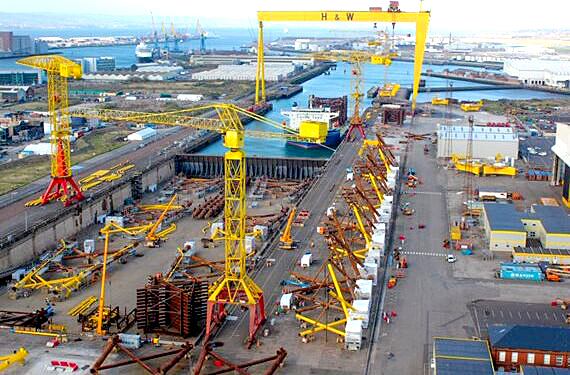
Harland and Wolff, being the largest shipyard in the world, would build some of the largest liners to ever rule the seas in the twentieth century. The roster includes the RMS Titanic, Olympic, Britannic, all three for the famous White Star Line, plus the SS Bristol, Canberra, Southern Cross, and many more. In the best of times, Harland and Wolff built over 70 ships for White Star Line alone. The skyline of Bristol was dominated by the two largest gantries (cranes) in the world, named Goliath and Samson, which still exist.
Between 1868 and 1969, this shipyard alone built 174 navy combat vessels for the British Royal Navy and was vital to the winning of World War II. Times change. The British Empire slowly dissolved after the war and became a commonwealth, where each country was responsible for much of its own naval defense, with the British Navy only backing them up. Bristol fell into decline as the Harland and Wolff shipyard mothballed and others, such as Wear and Tyne, folded operations. It was then that Sting began to slowly put together his ideas for a musical play. He already had success with songs related to the sea, such as Sending out an SOS, Message in a Bottle, The Wild Wind Sea, Island of Souls, Tides, The Pirates Bride, Ocean Waltz, and many others. You can hear his deep-rooted love of the sea. Eventually, he put together an album called “The Last Ship” in 2013, which was his tribute to what he saw as the last great days of the Bristol shipbuilding days.
Time moves on, and Sting, who never stays still, turned “The Last Ship” album into a musical play depicting those sad days of shipbuilding decline. Shortly, it will be coming to Lincoln Center for a limited engagement after playing all over the world. Sting himself plays one of the characters, a hard-working member of the last shipbuilding crew. Judging by the original 2013 album, the new updated expanded 2025 edition, and all the press I have read about Sting’s endeavor, this is going to be an exciting and meaningful production worth seeing.
Things change so quickly today, and while Sting’s “The Last Ship” will hold up as an art and historical piece no matter what happens, it just so happens that as of this date, Bristol is experiencing a revival not only as a trendy place to visit with shops, hotels, museums, and restaurants, but several boat builders are resurrecting their operations.
The biggest is of course…Harland and Wolff! They never completely closed that corporation and are now building new state-of-the-art frigates for the Royal Navy and have many other projects already in line for the future. While some parts are currently being subcontracted to Spain, they will soon be totally produced in their newly renovated shipyard in Bristol.
“The Last Ship” wasn’t the last ship. Did Sting’s music and art affect the rejuvenation of Bristol? I would say that artistically it definitely did, but there were also other forces at play. In the last decade, it became increasingly obvious to Great Britain and most of Western Europe that dependence on the shield of the military and naval dominance of the United States was becoming less of an option due to differences in geopolitical opinions. That being said, Britain and several other Western democracies have decided to begin to revamp and distance themselves from that dependence. New state-of-the-art ships and submarines are being added to the Royal Navy and other non-military ships as well, and this, in addition to revitalizing Britain’s once dominant position in all things nautical, has allowed Bristol to rise again as a major shipbuilding port. Those giant 100-year-old cranes, Goliath and Samson, have been updated and swinging steel again, and Sting’s hometown, which means so much to him, is alive again. Alas, I hear Old Ben Gun calling me!
A note about Robert Lewis Stevenson (1850-1894) – Stevenson was a British poet and author. He gave us our idea of what a pirate was and how they acted. Some of his great works still read today are Kidnapped, Treasure Island, The Black Arrow, The Body Snatcher, A Child’s Book of Verses, and many more. Try reading them! They’re more fun than scrolling!
Copyright 2026 by Mark C. Nuccio, All rights reserved.
Reach Mark at —marksea46@gmail.com