In the last issue of LIBW, I wrote about why rum is the spirit most associated with boating and sailors. This month, let’s look into the varieties of rum to be found throughout the Caribbean.
Whether you drink ‘fhum’ in Martinique, rum in Barbados, or ‘ron’ in Puerto Rico, you’re drinking the Spirit of the Caribbean. The plethora of drinks found in the southern sea varies as much as the food, language and customs of the people. But not only are these spirits a reflection of the island where they are made, but they are also consumed in as many different ways as there are islands.
To appreciate the variety of spirits that are distilled in the islands, it’s helpful to understand the basics of the sugar-making process. In the early 16th and 17th centuries, mature sugar cane stalks were cut by hand in the fields and then carried in ox-drawn carts to wind or animal-powered mills where they were crushed to release the sweet juice. The juice was then boiled in a series of progressively smaller copper pots, the largest of which would contain a hundred or more gallons of juice. Although the copper pots were eventually replaced by cast iron ones of the same dimensions, the name “coppers” still refers to the vessel used to boil the sugar cane juice. Today, the conical stone foundations of windmills and the remnants of cast iron coppers can still be found on almost every island in the Caribbean.
After boiling for a few hours, the thickened, dark syrup was poured into clay pots and set aside. As the sugar pots cooled, some of the sugar crystallized. Molasses, the heavy black liquid that didn’t crystallize, was separated from the crystallized sugar by opening a hole in the bottom of the pot. After a week or so, the sugar pots were broken and the coarse dark sugar called ‘muscovado’ was collected.
As a by-product of the crude sugar production process, the molasses collected from the sugar pots contained residual sugar that could be fermented to make a crude molasses wine. After a couple of weeks, the fermented wine was heated and the alcohol-rich vapor collected, then condensed to make what Robert Lignon, a British loyalist who fled his country during the Civil War in 1651, described as “… a hot, vile liquor… called kill devil.” Although England, France and other European countries forbade the export of distilled spirits from their various Caribbean colonies, this alcohol was widely made and consumed throughout the islands.
Over the next 200 years, the sugar-making process became more and more mechanized with the introduction of the centrifuge and better filtering techniques. And in the last century, vacuum pans were employed to facilitate the complete separation of crystallized sugar from the heavy molasses. The distillation process has also been improved to yield alcohol that contains fewer impurities, but a few simple stills like those in use 400 years ago continue to make their precious spirits.
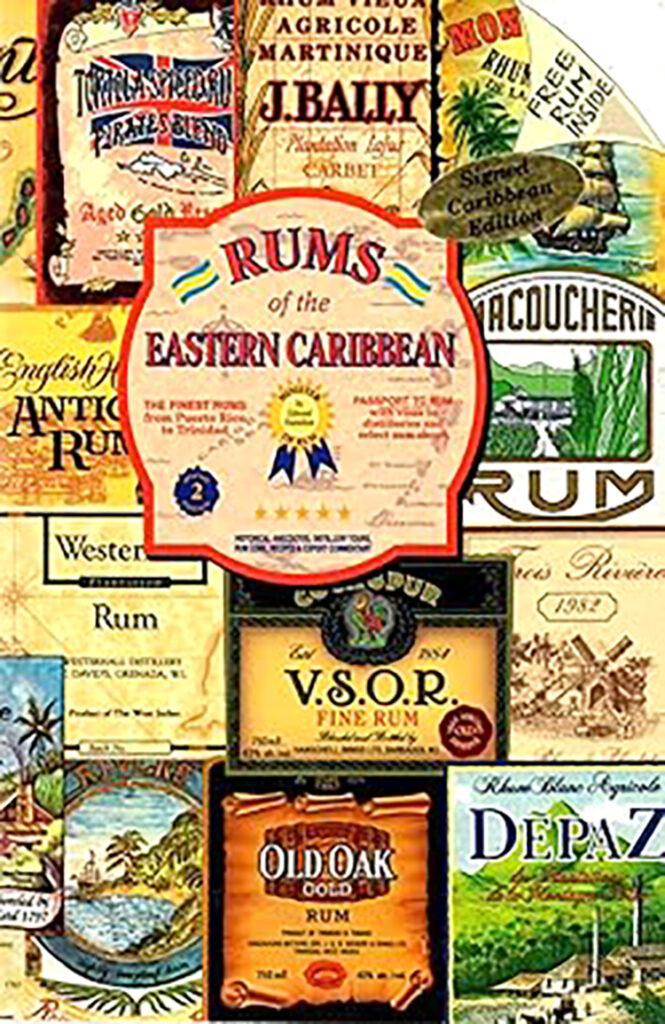
Today, on the English and Spanish-speaking islands, alcohol is made from fermented molasses and called ‘rum’ or ‘ron’ respectively. Even these spirits have molasses as their common raw ingredient and they vary from island to island. In Puerto Rico, for example, the rums are typically light in flavor and aroma due to the high distillation purity and carefully controlled fermentation. Don Q, the most popular rum (or ‘ron’ to be more correct) in Puerto Rico, is most often mixed with a fruit juice or cola. And despite being bottled as either a dark or white rum, the clear white rum is much more popular.
Five hundred miles to the southeast, the distilleries in Barbados also produce rum made from molasses, but these rums tend to be heavier in flavor and character since they are typically blended from spirits that have been distilled to different purities and then aged for smoothness. The yeast used for fermentation is also different from that used in Puerto Rico and gives the finished product a unique taste profile. In Barbados, aged products are popular, which are much more complex in character and somewhat smoother than the spirits found on some other English islands. Although mixed drinks are popular in Barbados, many Bajans drink their aged rum on the rocks or with a chaser of water on the side. But Bajans also enjoy healthy quantities of clear rum, generally mixed with tasty concoctions like sea moss, fruit juice, or coconut water.
On the island of St Vincent, where rum is also distilled from molasses, the local taste favors an over-proof, un-aged spirit, straight from the still. As its name would suggest, St. Vincent Very Strong Rum IS strong…. 160 U.S. proof to be precise and is drunk almost exclusively as a shot chased with water or cola. Guaranteed to take your breath away if you aren’t used to drinking strong rum, this rum is a very acquired taste.
On the French islands, you’ll find ‘rhum agricole.’ This aromatic spirit is distilled from fresh sugar cane juice and dominates the market in the French islands. Rhum agricole is typically distilled to only about 70% alcohol by volume according to local laws regulating the industry. Rhum agricole contains significant concentrations of impurities (acetyl aldehydes, light alcohols and fusel oils) and although these congeners could be removed by further distillation, they are responsible for much of the taste and aroma of the spirit. In spite of the fact that the distillation equipment used throughout the French islands is quite similar in configuration, there are differences in the spirits made in Guadeloupe, Martinique and Marie Galante.
Like the other islands, the French produce both white and dark rhums, but unlike the spirits found elsewhere, French white rhums are never aged, while the dark rhums are aged at least three years according to local laws. In contrast to the variety of drinks served in the other islands, white rhum agricole is drunk almost exclusively as a “ti punch” or little punch. As simple as this drink may be, it is always made with considerable ceremony. First, a little sugar cane syrup is poured into a short glass, into which a small wedge of lime is squeezed. After mixing these two ingredients, white rhum agricole is added and then stirred. There are slight variations to this drink; sometimes brown or white sugar is used, but the essence of the ‘ti punch’ is easily recognized. And depending on where you are, you may be offered ice to add to this especially flavorful drink.
Unlike the spirits served in other islands, French white rhum is bottled at 55 or 55% alcohol by volume, unless you are enjoying the spirit of the Galant Lady of the Isles, Marie Galante, where the white rhum agricole is bottled at 59% alcohol. On the other hand, most French dark rhums are bottled at 45% alcohol by volume, but there are exceptions.
Most of the molasses now used to make rum in the English and Spanish islands is imported from Central and South America. The French also make spirits from molasses, called ‘rhum undustriel’ or ‘rhum traditionnel,’ but the raw material is the by-product of the subsidized sugar industry on those islands. Most of these molasses-based spirits are shipped to France and used to make liquors and punches. Rhum industriel is cheaper to produce than the rhum agricole and the savings are passed on to the consumer, but this cheaper spirit is not considered a premium product even by those that produce it and is not widely drunk in the French islands.
In contrast to the molasses-based rum distilled in most English-speaking islands, Dominica’s Shillingford Estate, located between Martinique to the south and Guadeloupe to the north, makes rum from fresh sugar cane juice. Even though Shillingford employs a single column still similar to those used on neighboring islands, their Macoucherie Rum is distinctly different from French rhums due in part to the five-day fermentation process and the higher distillation purity achieved by the distiller.
With so many different drinks to enjoy, the question of which distillery makes the best rum is an obvious one. Ask any of the island distillers what makes the spirit they produce unique and you’ll invariably be told that the quality of their rum sets their products apart is the result of careful attention to detail. Not necessarily the details of fermentation or distillation, but more commonly, adherence to the tradition of making rum as it has been made at that distillery for the last hundred years or so.
As important as the spirit itself is, how is it being consumed? Fresh light rum is best drunk mixed with juice or your favorite carbonated beverage. But to really enjoy a fine aged rum, it should be served with water and a little ice, preferably on the side. Likewise, the French don’t drink their rhum with cola, and neither should you. Judging all the different spirits in the islands is like comparing red and white wine at the same table, but ask any rum drinker in the Caribbean which is the best rum and more than likely he or she will raise their glass of a favorite local spirit and tell you with enthusiasm, “This is the best rum in the world.”
So now that you are better advised, before you just automatically grab a familiar bottle of Bacardi or Captain Morgan, look over the other bottles in the rum section and perhaps make a more thoughtful choice.