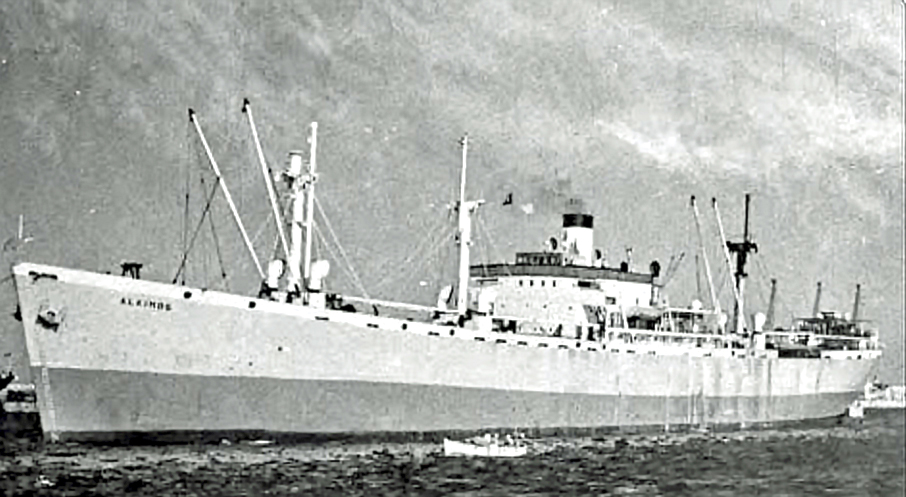
One of the most intriguing shipwrecks you’ve probably never heard about unless you live in Australia is the SS Alkimos. The Alkimos, originally named George M. Shriver’s was one of 2,710 Liberty Ships built by the U.S. during World War II. Later in her career, as a Greek-owned merchant ship, she was wrecked on the coast of Western Australia, north of Perth, in 1963. During her construction a deadly accident and later a murder suicide led to many believing the ship was haunted.
The Alkimos was built during World War II at the Bethlehem-Fairfield Shipyard in Baltimore, Maryland. She was part of the U.S. Liberty Ship program and was originally scheduled to be named the George M. Shriver. Changing the name of a vessel is sometimes thought to be unlucky and the Alkimos certainly was.
The bad luck started before the ship was even launched when several workers were unintentionally trapped in riveted-up compartments inside the ship. These unfortunate workers were found suffocated the following day.
The Alkimos was launched in October 1943 and was reassigned to the Norwegian Shipping & Trade Mission and re-christened Viggo Hansteen. She saw war service for about 18 months, mostly in the Mediterranean Sea. She was crewed by a mix of mariners from various nationalities. Serving as a troopship and transport in convoys, that were attacked by German aircraft and U-boats, she survived the war. Perhaps her luck had changed.
Unfortunately, on August 14, 1944, death stalked the ship again when she was docked at Naples Italy. Twenty-nine-year-old Canadian radio operator, Maude Steane, was reportedly shot by another crewmember, in his cabin, who then killed himself.
Maude Steane, from Toronto, was twenty-three when the war broke out. She is said to have been very patriotic and wanted to contribute to the war effort. She studied to be a wireless radio operator and graduated in 1943, she was the only woman in her class. She tried to join both the Canadian and Royal Navy’s but was turned down because she was a woman. She then applied to the Norwegian Shipping & Trade Mission and was hired as the Viggo Hansteen’s radio operator. She served on the ship until her murder at the age of twenty-eight, perhaps the victim of domestic violence. The motive for her murder remains a mystery.
After the War ended the Viggo Hansteen started her career as a merchant ship. While on a voyage from London to Port Chalmers, New Zealand she ran aground two miles northeast of the Katiki Point Lighthouse. The Port Chalmers tug Dunedin was dispatched to the scene and refloated the vessel. She was only slightly damaged.
In 1953 the Viggo Hansteen was sold to the London based Greek Faros Shipping Line and renamed Alkimos. The word in Greek meaning valiant, strong, or brave. The ship operated under the flag of Panama until 1959 when she was transferred to Greek registry.
On March 20, 1963 the Alkimos was on a voyage from Jakarta to Bunbury, Australia when she struck a reef off the Beagle Islands. She sustained considerable damage but was salvaged and towed to Fremantle in western Australia. She underwent repairs for two months and after a dispute over payment for the repairs was settled the Alkimos left Fremantle under tow.
Only a few hours out of port the tow line to the tug, Pacific Reserve, gave way and Alkimos was driven onto the shore. Although the ship remained intact all attempts to refloat her failed. She was left in the charge of an on-board caretaker.
The tug, Pacific Star, returned in January of 1964 and succeeded in refloating the ship. Later the planned journey to Manila, where she could be repaired, had hardly begun when the tug was seized by authorities. The Alkimos was left anchored until May 2 when a storm came up and she was driven onto the Eglinton Rocks. This time she was severely damaged and all thought of salvaging her was abandoned.
Later the derelict vessel was sold by the owners for scrap. However, as salvage workers started work on the Alkimos they were driven off the wreck by a mysterious fire. Every time thereafter that they tried to return the fire started again. In the years following the shipwreck twelve separate salvage attempts were made but all failed.
Today, the wreck has an evil reputation from divers and fishermen visiting the remains. Many became sick and others have had strings of bad luck after touching the wreck.
In 1997 an Australian diver decided to test the curse and swam out to the wreckage. It was a beautiful day with calm seas. Upon arriving he called out, “If there is a curse, show me.” Immediately a large wave crashed over him throwing him against the rusted side, cutting his arm. He looked up to see a massive flock of seabirds descending upon him. He described it as a scene from the movie The Birds.
Later, he became ill and after recovering he returned to the wreck. He swam out, touched the ship, and felt compelled to yell, “I’m sorry.” After that his luck changed and he was a skeptic no longer.