
It felt like spring would never come this year. April brought a solid start to the striper season on the west end of the island on both north and south shores. Now that it’s May, more migrating bass have made it to the east end and are consistently feeding and porgies, fluke, and bluefish are in season. Even the brilliantly colored and spotted unicorns, aka weakfish, are showing up.
The ocean bite for striped bass continues to impress from the NY Bite to Jones Inlet and even a bit east. Live bunker have taken credit for most catches, and soft plastic paddle tails and shads have performed well. Thanks to plenty of sunny days in mid-April, water temperatures have inched up nicely. These temps have fueled the back bay bites, where artificials have really shone. Bunker are in the bays, but there’s also several other baits that eager bass are ambushing. A smaller skinny profile is truly the best method to use in the hunt for back bay bass and my favorites in no specific order are:
½ to 1-ounce white bucktail (with real deer hair) and a Fat Cow eel tail jig strip
White bass assassin
Joe Baggs Swarter
Sp Minnows
Small Yozuri Mag Darter
Small NLBN or Jygpro paddle tail on a ½-1 ounce jig head
There can be an indifference from stripers in the ocean as to which tide they prefer. If there’s bait and birds, they’re going to feed. Look for patterns, though. If you had them one day, in the middle of the incoming on hard or soft structure, trust the pattern until you can’t trust it. When fishing the back bays, outgoing almost always out-fishes the incoming. As the tide pulls concentrated schools of smaller baits from creeks and estuaries, getting your offering into the ambush zone is vital. Depending on the size of the outflow from smaller areas of the bay, you don’t have to land a soft plastic or lure in there. Bass will set up when the true flow of the tide grabs these baits in larger swaths of water where there’s few, if any, spots for them to hide. For scenarios in marshy areas, the banks of the marshes hold glass shrimp, crabs and other smaller baits also swept up in the flow and the stripers know it. Look for portions of the marsh that are sheltered from the moving tide, and you’ll most likely find bait and stripers.
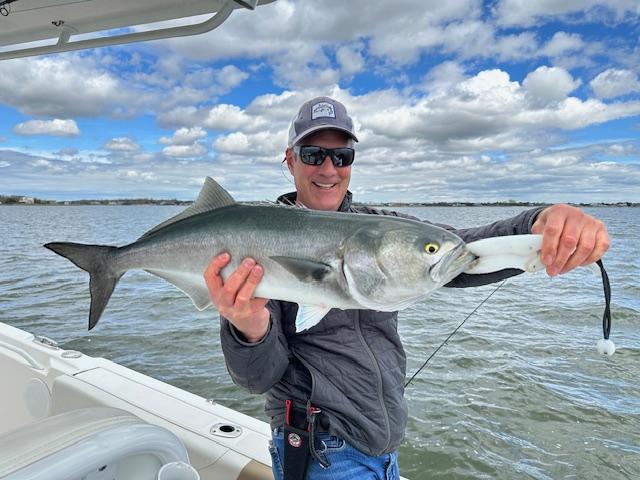
A big advantage of fishing the western south shore and western sound in April is the abundance of bunker and almost exclusively striped bass on them. To the east, though, where ospreys fly overhead throughout April with adult bunker in their talons, it’s a short window that shuts in early May when the stripers have the run of the bays. Annoying and exciting at the same time is that first take that feels like the biggest bass hit of the season, only to reel up a half-chewed soft plastic compliments of the yellow-eyed demons arriving. The intense action of catching the first wave of bluefish that make their way into the bays far outweighs sacrificing a few paddle tails. Indiscriminate feeders, blues will eat anything and everything.
Surface plugs and the vicious takes are a thing of beauty, yet sometimes they’ll stay subsurface. I always start a session with reasonably priced poppers like a Tsunami Talking Popper or Cotton Cordell Pencil. The front treble is useless and I always remove it. Unlike bass that attack a bait from the head, bluefish go for the tail. Having the front treble is just going to bury the plug deeper in the fish’s mouth. Most likely, you lose the plug with their sharp teeth close to your leader, and very likely during landing, a treble is going to end up hooked on you and in a worst-case scenario the fish at the same time. I’ve been using a single tail hook on poppers. When the blues are around, there’s a lot of them. Typically, not table fare unless you have a smoker and a solid recipe for blue fish dip, the ease of landing and releasing with a single hook, I’ll take any day over losing a fish here or there.
If the surface bite isn’t happening, diamond jigs and tins like Hopkins or Kastmasters are a good way to see if they’re on the bottom. The bass are still around, and the competitive feed instinct can often bring the nice surprise of a striper while targeting blues.
Fluke season starts on May 4th. Last year’s season overall was a bit of a disappointment. I always like the first few weeks of fluke season, since the bite always surprises me for a summer staple fish biting in May. Porgy season is open as well.
Get out there and fish!!! Tight lines.