What would you think of a captain whom you commissioned and paid to take you to a specific place to land, build a colony, and deliver you to another spot over 200 miles away? Not very much, I’d say. That is exactly what happened when a ship called the Mayflower, and its captain, Christopher Jones, was hired by a group of Puritans in 1620, to take them to the mouth of the Hudson River, where they were granted the right to build a colony by the King. Instead, they landed on a spit of land at the tip of what is now called Cape Cod. They spent their first winter aboard the Mayflower. The next year, they would move to the mainland and found Plymouth Colony. This is their story.
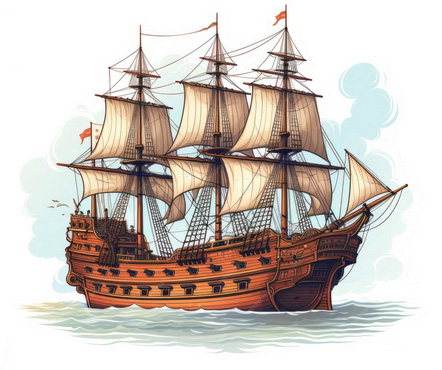
There are 30 million people in the United States who proudly claim hereditary ties to the 102 passengers who made that historic crossing. Even my aunt, Annunziata Della Buongiorno, has a plaque on her wall attesting to having made that journey. She also has a signed document from NASA saying she visited Mars in 1973. What the h–, she makes wonderful handmade lobster ravioli! The Mayflower had a crew of 39. By the standard of her time, she was hardly a large vessel, measuring only 80 ft. from stem to stern with a beam of 24 ft. She could carry 180 tons of cargo, and her mid-deck was armed with 8 cannons. This is where the passengers stayed, as it was enclosed from the weather except when the gun ports were opened. It had a ceiling height of 5 ft 4 in. Many of the taller Puritan men spent their days banging their heads and using Puritan expletives such as “Darn it, gosh darn it,” and once, even a “@%$#*XHT” was heard. On the main deck was a cabin for the captain that was aft and a smaller one forward. The crew slept on the open deck when the weather was bearable, and anywhere they could fit to get out of the weather if it was foul. She carried two large masts, the rear one being gaff rigged with a small sail and a bow sprit with a small sail on her bow.
Now the pilgrims were leaving England to find religious freedom,
for their little community, yet as a group they had one common negative personality trait in that they were rather intolerant of anyone who wasn’t a member of their particular path to God, an anomaly amongst religions that generally accept other faiths. The Puritans were a male-dominated congregation who had a history of religious issues in England, then Holland, then back in England, and finally in North America. The King gave them land in what today is Manhattan and the surrounding Hudson just to get rid of them. Later, they had issues amongst themselves when they started accusing each other of being witches and hanging and burning anyone who didn’t fit into their new community directives to “protect” religious freedom. But ah! I digress!
The voyage was to be four months, give or take. They left England on September 16, 1620. The Mayflower was a cargo vessel and not conducive to carrying passengers. Accommodations were almost as bad as flying coach on today’s airlines, though plane food is slightly better and not filled with crawling weevils as the Mayflower’s foodstuffs were. Everything was either soaking wet or very, very damp. Rats were constant companions below decks and were oftentimes mistaken for children during the dark nights below decks. For entertainment, the Pilgrims either prayed or counted roaches in the candlelight. Needless to say, the showers and toilets weren’t working, nor was the washer and dryer; therefore, everyone had a rather rank odor, but it didn’t bother these steadfast Pilgrims because they all reeked, yet exceedingly less than the crew.
The Mayflower itself was far from being in “Ship Shape” condition. It rode poorly in following seas. When the wind was at its back, it tended to buck into the waves under those conditions. When they left England, the weather was fair, and the passengers could go outside on the main deck and enjoy the warm sun. For a while, it seemed like everyone was on an elegant Caribbean cruise, except there was no all-night chocolate bar. Even the three pregnant women aboard felt comfortable, and one had an easy childbirth of a boy she named ‘Oceanus.” But “Ah! What fools we mortals be!” The weather changed as the Autumn storms raced up the Atlantic coast and moved right into the Mayflower’s path, making the latter half of the voyage a s—t show of epic proportions. Many passengers became seasick, so the sounds of passengers ‘’tossing up’’ drowned out the shrieks of “We’re all gonna die!” There were no stewards to clean it up, so it sloshed from port to starboard and back again. The crew spent sleepless nights trying to keep the vessel intact. Suddenly, one of the two main masts cracked and split, putting the entire ship in danger. Should the mast not hold up, it would end up crashing upon the deck. All would be lost! The crew was finally able to secure it so that it was somewhat stable.
Meanwhile, Captain Jones was sealed in his cabin, drinking another bottle of port and trying to figure out where the tumble he was. It was then he realized that he left his compass, sextant, parallel rules and all his charts in the “Flying Pig Sailors Brew House” he visited for one more round before striding up the gang plank in his threadbare uniform with his rusted medal from the Spanish wars attached below one of his mismatched epilates, the left being green and the right being red which in itself tells you a lot. All was not lost, however; he knew if he kept the ship completely off course, he would eventually run into land. Captain Jones didn’t spot land first. His eyes weren’t that good, and he left his telescope in the bar with the other essential navigational equipment. It was an old crewman named “Blind Billy” who spotted land first. All the puritans got into their happy dance mood on the rotten deck as the crew began to lower the patched sails, entered a small harbor, and set the anchor. That land is now called Province Town at the tip of Cape Cod. There is a monument there called “The Pilgrim’s Monument.” You can climb to the top of this tower and overlook the little town that grew around where they first set foot on land. They took the ship’s boat, rowed to shore, fell to their knees, and thanked God for delivering them to the mouth of the Hudson River and giving them this new land. When they stood up, a Native American was standing regally before them. He was a Wampandoag, and he spoke English, which he learned from “The Idiot’s Guide to Learning English” that had washed up on shore a few years before. His name was Squanto. He had the privilege of telling these newly arrived Puritans that the Hudson was 200 miles “That way,” and this was not their land. It was Wampanoag land.
To make a short story longer, the Pilgrims spent the winter on the Mayflower. They wouldn’t have survived without Wampandoag’s help. Eventually, the Wampanoags gave them land in Plymouth to build their colony on. The Mayflower left with her crew as other ships came to resupply the colony with goods and more immigrants. For the Wampandoags, their benevolence was their undoing. As New England grew, the Wampandoags were warred upon, picked up European diseases, had their land stolen, and their once mighty tribe of over 300,000 was reduced to a handful of poor, neglected people. Recently, they have begun to demand their rights.
Captain Jones did not live long after his return to England. Upon his death, his widow desperately tried to sell the Mayflower, but it was declared unserviceable and was scrapped. Widow Jones died penniless, while the Puritans and their descendants eventually took all of America with land grabs of Native American lands, breaking peace treaty after treaty, giving them blankets and goods infected with smallpox, which would destroy villages and entire tribes, and constantly making war against them. Ironically, the Puritans came to America for religious freedom, yet the United States Government sought to break Native American children of their native religions, traditions, and languages at the Carlyle Schools set up by Anglos in the 1870s and continuing into the mid 1960s. Today, all Native Americans are going back to their roots and demanding their rights, which are long overdue.
I admire that little band of Puritans for leaving Europe and venturing here. They had guts. As the Plymouth grew, they built a bountiful community. But I do wonder, especially in the geopolitical turmoil we currently live in, what would have happened if the Mayflower’s erstwhile captain had mistakenly dropped them off in Greenland. How history would be different.
Copyright 2026 by Mark C. Nuccio, all rights reserved.
Complaints and tirades-marksea462gmail.com