May always seems to me like the gateway to summer. Lilacs are blooming, grass is green, the fish are arriving in waves with every tide and moon, and for some reason a campfire and a cold beer begin to call my name every weekend. I recently joked to my wife that just as we see bugs “sun hatch” during the first couple legitimately warm days of the year, if we’re being honest, people sun hatch too! You see it in March and April on those occasionally unseasonably warm days. The gardening centers are flooded with people, yardwork begins in earnest even if there’s nothing really to be planted yet. I’m guilty of that this year for sure. But in May…things get real. Just as those long-awaited gardens begin to show some life beyond just a hopefully sprout or two, so do our local waters. The May moons in particular are rife with tales of giant striped bass being pushed in if you know where to look. Tales of bluefish begin to emerge near large river mouths. And the fishing goes from “hoping” to catch something to “expecting” to catch something. It’s one of my favorite months of the year, not necessarily for fishing, but for the overall feeling of being on the precipice of summer weather, lobster rolls, and screaming drags.
Freshwater
May can be a really rewarding month for those pursuing largemouth bass. But it takes a bit of research and understanding to really put yourself in prime position to have a great day. Typically, May will include portions of pre-spawn, spawn, and post-spawn patterns depending on a variety of factors. One of those factors is the size of the body of water you’re fishing. In Connecticut, we have both large, deep lakes and smaller, shallower lakes. Those shallower lakes are going to warm much quicker in May, and so bass may begin to move into spawning mode sooner than those in large lakes, where they could potentially be staging deeper and still in more of a pre-spawn mode. There can also be different patterns within different parts of the same lake. An example would be a southern facing cove warming quicker than a northern facing one. In that southern facing cove, your water might initiate spawning behaviors, whereas on a different part of the lake if you fish the same pattern in a northern facing cove, you might strike out. You should try to be very aware of water temps, which portion of the lake you’re on, and how big and deep overall the body of water you’re fishing is.
If you are searching for pre-spawn bass, you’re probably going to want to cover some water with a spinnerbait, chatterbait, or crankbait. Vary your depth, try to find emerging weed lines or rocky transitions, and react to what you see. If you find yourself spotting some spawning beds, slow things down using soft plastics or creature baits or jigs. You may want to come prepared with several types of baits tied onto your rods and keep varying your approach until you see a pattern emerge. The key for May is figuring out your body of water and what phase the fish are in. From there, you can zoom in.
Saltwater
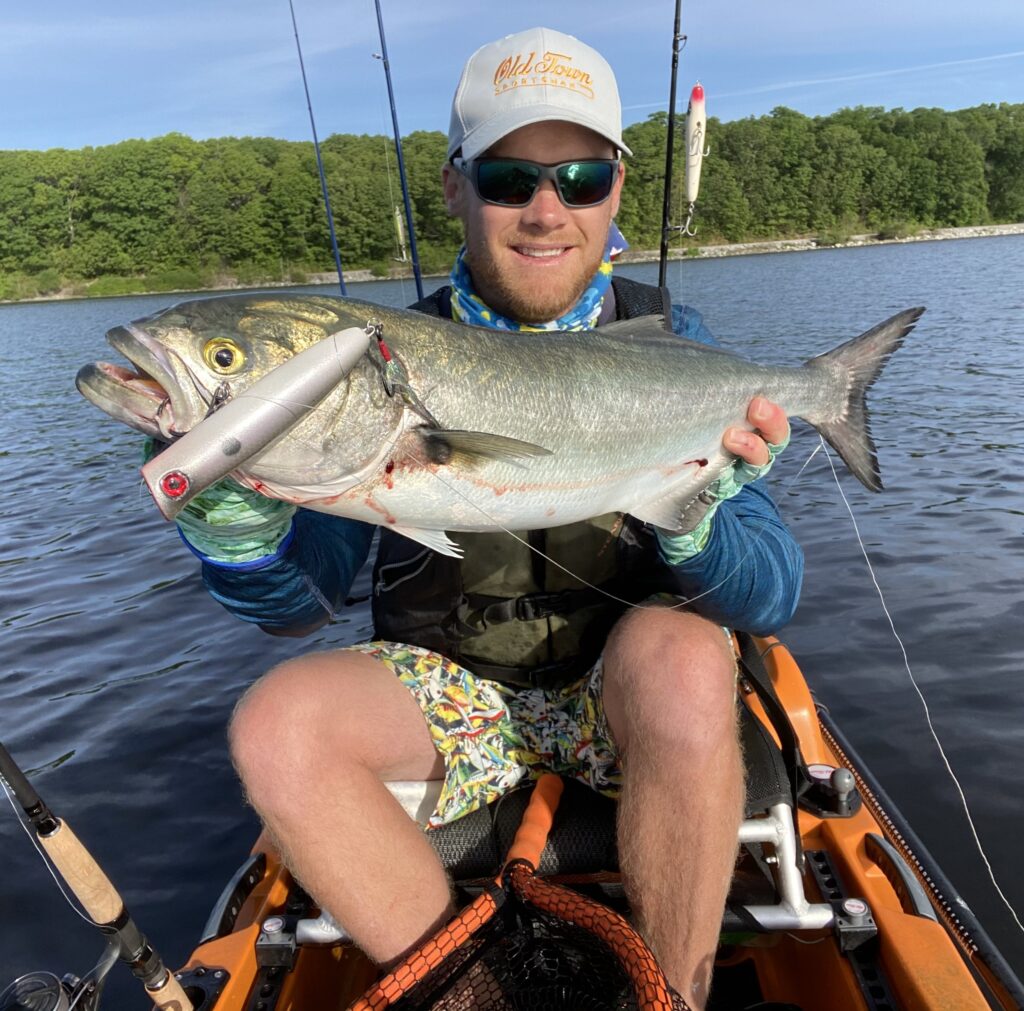
May is a really fun month for our local saltwater anglers. Not necessarily because there are guarantees of fishing being really good or there being a lot of fish around. But because May is filled with surprises. I remember a few years back I was poking around with a buddy for some early season stripers. We were focusing on some areas we knew well, but not having much luck. At one point I decided to change locations and began pedaling my kayak over much deeper water while trolling a bucktail just for fun. I didn’t go more than 30 yards before my rod shot back and I was tight. I was very confused…trolling in 60’ of water isn’t exactly where I anticipated finding a bite. But I fought the fish, which gave me hell, and in a short time I saw a pretty darn good-sized bluefish come up. Typical bluefish mayhem ensued, but once I released it I swung back through the same area and watched my fish finder. And wouldn’t you believe it, there were piles of really nice bluefish staged 15’ down just hanging out. That began two hours of topwater insanity as we both pulled in as many bluefish as we could. To me, that’s why May can be fun. You aren’t always going to strike it rich, but when you do it’s often the first really fun bite of the year.
For bluefish in particular, large river mouths are often where we begin to see them arrive. They occasionally be very picky, which can be frustrating. But if they’re chewing, it’s a blast. I usually use a Daiwa SP Minnow to troll a lot early in the year unless I’m seeing something on my electronics worth casting at. Topwaters are also great in May. I prefer poppers, as they move slower and give the fish more of a chance to really see and eat the bait. The best part about bluefish is that they’re rarely alone, so if you find one you should absolutely stay in the area and give it hell.
Stripers in May can be found in a few different places. The local holdover fish should be dropping out or getting very active depending on the time of the month. For smaller holdover fish I often use 5-7inch soft plastics fished weightless or with a light jighead on them. You can bounce and swing the bait along the bottom into schools of fish, which can be fired up or tough to get to bite depending. Migratory fish will also begin to arrive in May. When specifically, is anyone’s guess, but often you hear whispers around the moons of some good fish moving in. Flats, river mouths, and anywhere there’s a herring run are good places to begin your search for bigger striped bass. And imitating those herring/bunker is always my first tactic. Soft plastics, small topwaters, and shallow-diving plugs are a great early trifecta of options.
The beginning of May and the end of May are radically different from one another in terms of our local striped bass fishery. In early May, you’re looking for active early fish, but by late May you’re trying to hunt down your first big migrators of the year. So, I always try to stay as active as the fish are. Change spots, change tactics, cover ground, drive a bit to a new launch if needed. But be prepared for change!