The lighthouse is a historic house situated on Turtle Island, a privately owned island in Maumee Bay on Lake Erie, which is divided between the U.S. states of Michigan and Ohio near the mouth of the Maumee River.
The island (about seven acres) was named after a Miami Chief, “Little Turtle” (1752-1812) due to his role in treaties and battles, and was acquired by the U.S. government in 1831 for $300.
The lighthouse was erected in 1932, the earliest in the region. It first had a 40-foot conical tower that had an octagonal black lantern, which housed eight lamps as well as reflectors that provided a white light. The lighthouse also had a 1.5-story keepers’ dwelling. A fourth-order Fresnel lens was added in 1857 and a boathouse was built to support the navigational role. The lighthouse was rebuilt in 1866 and a new 45-foot tower was made of Milwaukee brick and a cast-iron staircase.
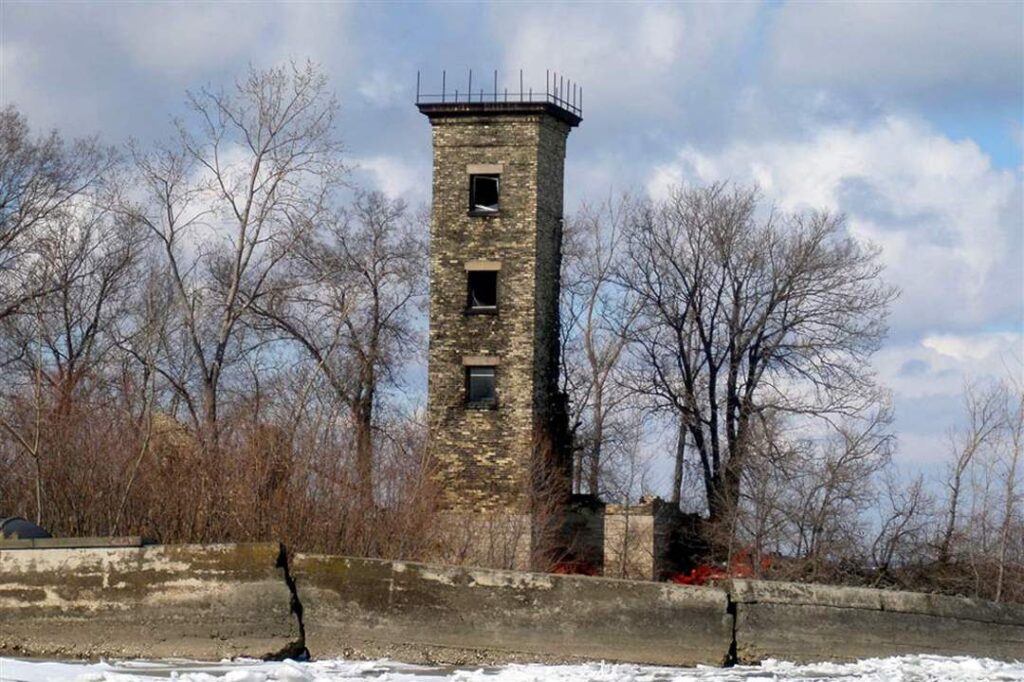
During the 72 years of operation (1832-1904), the lighthouse helped guide ships, tended by keepers, one of whom was Samuel Choate. Erosion from Lake Erie storms shrank the island to about 0.5 acres by the mid-19th century. There was pile-driven work done in the 1830s, costing $16,700, and a concrete retaining wall was built in 1884 to preserve it.
The lighthouse was decommissioned on May 15th, 1904, after the dredging of a deeper shipping channel, Maumee Bay, with the start-up of the Toledo Harbor Light on May 23rd, 1904. The lighthouse was sold at an auction for $1,650.
Early Construction & Establishment
Turtle Lighthouse was erected in 1832. It guided vessels to the entrance of the Lake Erie from the Maumee River. Philo Scoville designed the lighthouse. It also had a dining room, bedroom, kitchen, and parlor. The Island rapidly eroded because of Lake Erie’s waves as well as fluctuating water levels. Congressional efforts to help stabilize the site in the 1830s included funding for protective measures, but they failed to stop degradation. The need for major upgrades was necessary for reconstruction in 1866.
In 1866, a new structure was built on Turtle Island, costing $12,000. The height was 45 feet. It was a square tower attached to a church-style one-and-a-half-story keepers’ dwelling. Inside was a cast-iron spiral staircase along with a black lantern room. This replacement was considered the finest light station on the Great Lakes. The tower had a fourth-order Fresnel lens that provided a fixed white light. The lens was known for its ability to refract and focus light, which provided visibility up to 14 miles during optimal conditions. After building the tower, additional facilities were added, along with a fog bell and a well.
A concrete seawall was built around the islands’ exposed sides in 1884 for protection. A storm house located at the dwellings near the entrance was also constructed. Storm sashes for windows, with a cellar excavation beneath the keeper’s quarters, were added.
Decommissioning
The Turtle Island Lighthouse was decommissioned on May 15th, 1904 for a newly constructed-Toledo Harbor Light that would guide vessels into the shipping channel.
The transition was the end of the lighthouses’ role in making the entrance to Maumee River and rendering it obsolete. The reason for the decommission was for advancements in navigation infrastructure, the dredging of a deeper channel through Maumee Bay for the accommodation of larger vessels. After the deactivation, the U.S. Lighthouse Service removed essential apparatus from the tower and transferred it to the Maumee Bay range lights before it was sent to the lighthouse depot in Buffalo, NY. The island that encompassed the house, dwelling, boathouse, orchard and garden was auctioned off by the government in December 1904.
It was sold to a private buyer, A.H. Merrill, for $1,650. Later on, the island included a short-lived yacht club, but due to its remoteness and vandalism, it was abandoned.
From the activation in 1832 until the deactivation in 1904 (72 years), there were 18 head keepers and assistants. Samuel Choate served from 1832 to 1834. He passed away from cholera in 1834. He had a son, Seth, who had two children and a wife alone on the island. When Seth died, his wife and children remained there until being rescued by a sailor. Ann. M. Edson was the first woman to serve as head keeper in 1869-1872 after the death of her husband, Nathan W. Edson. He held the position since 1867. William Haynes served as the longest-tenured head keeper 1875 until the light was decommissioned. He raised his family on the island and was credited with rescuing seven people.
The end of the keepers’ assignments came about in 1904 as navigation began shifting to more advanced structures in the area.