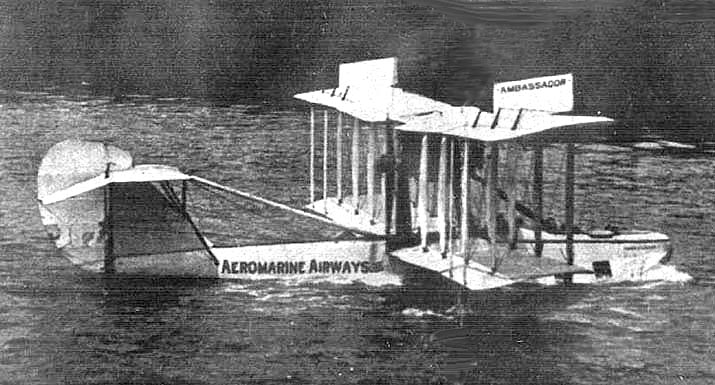
The flight of twelve United States Navy aircraft lumbered one by one out of the twilight sky and slowly slid across the flat waters of Gravesend Bay. Under orders of the United States Navy, the aircraft were to assist in the already forty-plus-hour search for a missing civilian aircraft, the Ambassador II. With the last fleeting glimmers of the late August sun sneaking below the horizon, the naval aviators knew that the following morning would require an early launch. Two of their former service’s shipmates, one an aviator, the other a mechanic and a passenger, had been lost somewhere in the Atlantic Ocean. As the hours crept by, the chances of survival, even with the warmth of the late summer waters, slipped away like the sun’s last glimmers. The aircraft, one of the Aeromarine Airways fleet of sightseeing aircraft, and her three occupants were overdue and presumed down in the water. The search, the naval aviators knew, would continue in the morning.
Hours later, three men, who had been awash aboard a nearly swamped small dory, splashed into the churning surf and clamored up the cold and wet-packed sand of the strand. Exhausted but relieved to finally feel terra firma under their feet, the three men thanked their blessings. Assisting one another to their feet from the shallows of the beach break, the glimmer of civilization beckoned serenely as if the lights were notes sung by a siren of the sea. The men, bedraggled from their forced landing on the open ocean, their exposure to the elements, and their lack of sleep and food, trudged into the lobby of the Nassau Hotel. With his outstretched, salty and wet hand, one of the men rang the front desk bell. The ring of the silver bell resonated through the empty, cavernous lobby. No other guests were occupying the space at the ungodly hour of the morning, and the sodden trio were a far cry from the normal appearance of guests of the hotel. The night manager dutifully arrived at the desk bedecked in his starched uniform tunic. He looked those men over. “May I help you gentlemen?” he offered dryly.
Roughly forty-three hours earlier, Captain W.T. Miller donned his leather aviator cap and slipped into the cockpit of the seaplane as it bobbed in the calm waters of the Hudson River at the Aeromarine Airways water-based airport office and terminal at 79th Street. A United States Navy veteran, Miller had been an aviator attached to the Torpedo Airplane Division of the Atlantic Fleet and had also flown in the skies over Europe during World War One. At age twenty-six, Miller had been working as a pilot for Aeromarine Airways for two years. His mechanic aboard the flight, Harold Thompson, was also a veteran and both men had countless hours in various aircraft. Their paying guest for the skyward sightseeing sojourn was Mr. V.S. Robinson, of Pittsburgh, Pennsylvania. The flight plan was straightforward and typical. The seaplane would alight from the waters of the Hudson River, take a slow flight out to the Fire Island Lightship, south of Long Island, New York, and then loop back to her home waters. For Captain Miller, it was as routine as routine could be. Then again, any good pilot worth his salt knew that no flight was ever routine. With pre-flight checks completed, Miller alighted Ambassador II into the air. Another scheduled sightseeing flight with Aeromarine Airways had begun.
Aeromarine Airways, Incorporated, was born in the wake of World War I. It had evolved out of two important components. First, a glut of war surplus aircraft and a dream by a man who felt that there was a unique opportunity to conquer the heavenly domains with the establishment of a commercial aviation company. Inglis M. Uppercu was one such dreamer. Leaving Columbia Law School without his degree in 1902 to make his mark on the world with automobiles, he started his own automobile company. Within six years, he had secured an exclusive franchise to sell Cadillacs in the New York and New Jersey markets. Buoyed by the profits from his automobile adventures, he was bitten by the emerging technology of airplanes and aviation. His first “flight” into the industry was in the creation and the financial backing of the Boland Aeroplane Company. Sadly, the namesake of the company, designer Frank Boland, crashed an experimental aircraft of his own design and perished while making a sales pitch, unsuccessfully, in South America. Down but certainly not out, Uppercu still believed in the future of aviation. In 1914, he founded the Aeromarine Plane and Motor Company and began building seaplanes. The timing was perfect for the fledgling company and a U.S. Navy contract for two hundred seaplanes for two million dollars established the company as a major player in seaplane production. With a plant and factory designed and built on the Raritan Bay in Keyport, New Jersey, the company had created one of the finest aircraft factories in the entire nation. But wars come to an end and military contracts disappear until the next rattling of sabers. Despite a plan to convert operations for the civilian market, Uppercu’s prospects appeared grounded. Though Uppercu jockeyed and advocated for governmental financial support for commercial aviation, the United States Government expressed no interest. They had their own albatross to tackle.
Despite the setbacks, Uppercu had a new idea to revitalize his aviation pursuits and bolster his company’s bottom line. With a glut of war surplus aircraft in crates, he persuaded the United States Navy to enter into an exclusive agreement for his company to recondition and modify the war-surplus F5L’s for civilian and commercial enterprises. By 1920, America was introduced to the company’s modified seaplane that would serve as the benchmark, at the time, for commercial aircraft. The aircraft’s glimmer of possibilities, though, was dimmed by the grey storm clouds of financial uncertainty that continued to loom over the nation. Unwavering in the feasibility and prospects of his business model, Uppercu established the Aeromarine Sightseeing and Navigation Company. In its first summer, the modified F5L seaplane had carried “more than 1,000 passengers between New York City and the resorts of Atlantic City, Southampton, and Newport.” The gamble appeared to have worked. The public began believing in the safety and reliability of aviation.
Though Aeromarine Airways had an impressive and perfect record of safety, the financial outlook remained equally bleak for the company as well as the country. Ironically, Prohibition offered a silver lining for many who saw an opportunity to cash in on alcohol sales – legality be damned – when most saw empty glasses. Though several fly-by-wire and amateur conglomerates attempted to cash in by establishing air routes to wet locations, believing that there might be a market for those who wanted to continue to wet their whistles on some liquid libations in Caribbean ports of call, it would be a nominal postal contract between Key West and Havana, Cuba, that would help float Aeromarine Airways’ future. The contract ultimately assisted in keeping the company on the right side of the financial ledger as Uppercu expanded with the Aeromarine-West Indies Airways routes in southern Florida. Seasonal service in the northeast was also maintained between New York, Atlantic City, and several ports in New England. And it was with that service from the Hudson River terminal that Ambassador II alighted for its flight to the Fire Island Lightship on the morning of August 20, 1922.
When the flight was listed as overdue, the operating manager of Aeromarine Airways, Major Bernard L. Smith, readied his pilots and crew to go aloft. While radio messages flooded the airways and a host of United States Navy and United States Coast Guard assets launched throughout the region, several aircraft from Aeromarine Airways were launched, including the Nina, a fourteen-passenger seaplane, the Ritz-Carlton, and two other smaller aircraft, including the Biltmore, to assist in the search.
Despite the efforts of the overhead aircraft and the waterborne vessels that comprised submarine chasers, patrol boats, and tugboats, no sight of Ambassador II, or her three occupants, was reported. Several hours stretched into a full day. As the hours dragged, so too did the hopes of a successful rescue of the three lost men. As the search began to creep into a third day, little did the rescuers of the largest air-sea armada know that the three men were safe and sound at the Nassau Hotel in Long Beach.
After donning borrowed duds, sharing a warm meal rustled up by the overnight staff of the hotel’s restaurant, and a quick return to their dried attire, the three men of the Ambassador II quickly parted ways. Mr. V.S. Robinson caught up with some friends and hastily boarded a train bound for Atlantic City, New Jersey, to rejoin his family. Miller and Thompson boarded a train bound for New York City’s Pennsylvania Station and then, at the Jamaica Station, shifted to a Brooklyn-bound train. An early morning knock on the door of Major Bernard L. Smith brought happy news of their safety. Major Smith listened to the story and then, with his two employees looking no worse for wear despite their forty-three-hour or so dip and impromptu voyage on windswept swells of the Atlantic Ocean, he sent them onto their next flying gig. Two paying passengers had requested a flight to Saratoga Springs, New York. Like the old theatre adage, the show must go on.
The press, however, knew that there was more to their story and pushed for an explanation on how the three men had survived the forced landing in the ocean and how they had managed to “wash” ashore in Long Beach. More importantly, the press and the United States Government were also a bit perplexed about how the three men had not been found by the countless overarching resources of various government agencies and numerous volunteers on the surface of the water and far above. The devil, it seemed, was in the details, and it was Major Smith’s job to ensure that he helped control the narrative. For the press, the details were scant. Initial reports released were minimal and offered only vague and innocuous information.
While at twelve hundred or so feet, the engine failed. Miller slowly brought the seaplane down to the water and safely landed between the crests of the offshore swells. After ensuring everyone was safe, Miller and Thompson began troubleshooting the problem. A part of the engine’s drive gear was broken. There was no way to address the problem floating in the waters of the Atlantic Ocean. They would need a tow to shore to fix it. For several hours, Ambassador II floated aimlessly without sighting a single vessel or aircraft. Finally, a small fishing schooner was spotted in the distance. Miller reached for his Very pistol and in short order, signal flares rocketed into the air. The fishing schooner slowly turned and began heading in their direction. Finally, the men rejoiced in salvation.
As the fishing schooner neared, Miller, Thompson, and Robinson began to question their definition of salvation. The schooner was small and appeared barely seaworthy. The alternative, though was also bleak. The three men transferred to the schooner and were heartily greeted by the barely English-speaking skipper and crew. The men aboard, according to Miller, appeared to be Cubans and he believed that the schooner hailed from the Bahamas. Though Miller wanted to tow the stricken seaplane to safety, the skipper indicated that the schooner was not capable of such a recovery, especially with the rough sea conditions and winds. As Miller and his companions attempted to feel relief from their circumstances, they realized that their relief would be short-lived, at best, under the circumstances of their current precarious predicament. Ambassador II was abandoned and was soon in the wake of the fishing schooner. Despite the efforts of the crew, the sea and wind conditions offered little respite for the fishing schooner and its plans for providing safe passage to a nearby port of call for Miller and his companions. Hours later, the conditions abated and the schooner made its way closer to the coastline.
When the schooner was roughly a half-mile offshore, the skipper motioned toward Miller and his two flying compatriots that the time had come for the next “step” in their voyage home. A small dory, which appeared even less seaworthy than the schooner, was offered to the three men to make the final run to safety. Miller, not wanting to be disrespectful of the offer, thanked the skipper and his crew and handed over twenty-five dollars for their efforts. Miller, Thompson and Robinson, cautiously and very carefully, boarded the dory and began to make their way toward the coastline. Maintaining a balance between rowing and bailing, the small dory and her three occupants finally made it to the shallows. With the dory slowly swallowed by the beach break, the three men waded ashore to the safety of the strand. The schooner, offshore, slowly disappeared into the inky black of the night. The men of the Ambassador II had survived their forced landing.
Major Smith had bought some time by redirecting his pilot and crewman for a flight north, but he knew that he could not avoid the scrutiny of the press, who would be pressing him and the company for more detailed information. As he exited the front door of his home the following morning, he handed out copies of a typed statement. When pressed for more information, Major Smith offered only “that’s all.” With the quick flash of a smile and a wave of his hand, Major Smith slinked back behind the front door of his home. Reporters requested more details but were rebuffed by the operating manager. The reporters would seek information elsewhere. Meanwhile, representatives of the United States Government would not be as easily dissuaded from gathering additional information or offering their own opinion on the matter.
With the Rum Row operating along the approaches to New York and New Jersey, it did not take Pinkerton’s finest to ponder whether Ambassador II had been involved in some less-than-legal activities with the footloose, floating faction of prohibition profiteers purposively positioned out of the reach of the long arm of the law. While most government officials, including Prohibition Chief John D. Appleby, would not directly accuse Aeromarine Airways of any nefarious activities associated with the smugglers, they certainly wanted more information about the fishing schooner that had rescued the three drenched men from the open ocean. Others, speaking under anonymity, went so far as to say that the Ambassador II had not been lost but had been on a “bootlegging trip” that went bad. When reporters sought information about Mr. V.S. Robinson of Pittsburgh, Pennsylvania, they went bottom-up. According to their cronies working the Pittsburgh beat, there was no V.S. Robinson in their burg. It appeared that the mysterious passenger was nothing more than a gaslighting ghost.
While the circumstances of their rescue by the “flying dutchman” like schooner, a fishing rigged boat that had no fish but also had no booze, had answered some questions of the rescue and watery arrival on the sands of Long Beach, it had also raised a few others. With Prohibition in full effect, the schooner with no name had raised suspicion among many of the “dry’s.” Was the schooner a rum runner and part of the alleged Rum Row that operated in the waters offshore and was responsible for ferrying nefarious swill to the sandy beaches and backwater marshes of the region? Who were these mystery “fishermen,” and how come the schooner, far offshore, had no fish aboard? Either the skipper and salts were the worst fishermen this side of the grand banks or they were rum runners who had stowed their nets and poles to catch and land a more prized bounty for the land-bound drinkers who thirsted for a toast of the good stuff.
Though the air-sea search had been one of the largest ever launched during the early days of commercial aviation, the story quickly disappeared, like the shady passenger from Pittsburgh, from the pages of the dailies. Aeromarine Airways continued its services until 1924. The loss of four lives on a downed flight between Key West and Havana in January of 1923 and the subsequent loss of an unoccupied seaplane in Havana Harbor were two of the final nails in the financial coffin for Uppercu’s dream for a financially viable and successful commercial airways company. The Rum War would continue in earnest until the repeal of Prohibition in 1933 and the forced landing and the odd rescue of Miller, Thompson, and the mysterious man from Pittsburgh on August 21, 1922, would be a mere “wet” footnote of the “dry war” that occurred in our waters.