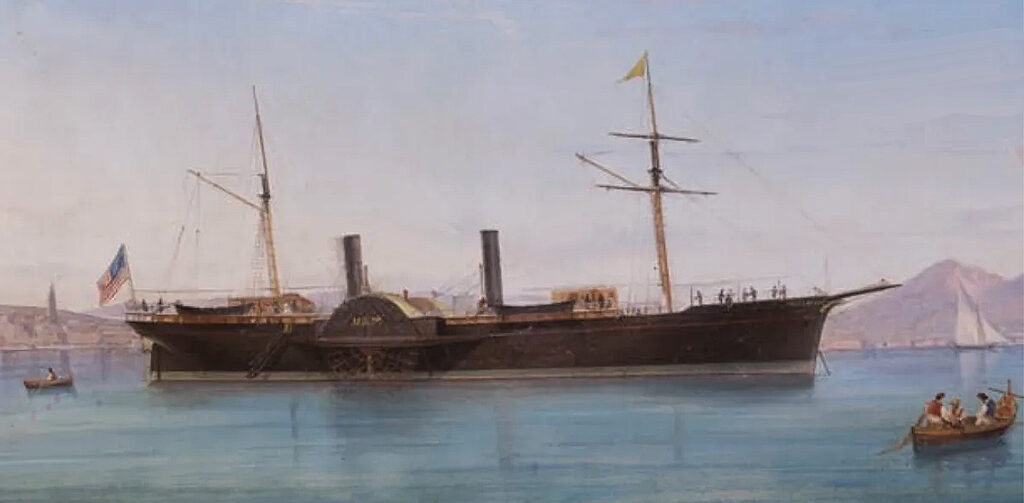
During the American civil war the USS Quaker City, a 1,428-ton side-wheel steamer, served in the Union Navy as a blockader. The ship was 244 ft. 8 in. long, with a beam of 36 ft. and she drew 13 ft. 6 in. Top speed was 13 knots. She was built in Philadelphia by Vaughn and Lynn shipyards as an ocean liner. In addition to her two steam powered paddlewheels, USS Quaker City carried three fully rigged masts for sailing. Her hull was made of wood. In December of 1961 she was chartered for a time then purchased by the US Navy and commissioned USS Quaker City. Her skipper was Commander James Frailey.
Soon after President Lincoln declared a blockade of the Confederate coast, USS Quaker City was one of the most active and effective blockaders in the Union Navy. The ship was stationed off the entrance to Chesapeake Bay, where USS Quaker City participated in the capture of the ship North Carolina on May 14th, 1862. Then the bark Pioneer in Hampton Roads on the 25th and the bark Winifred off Cape Henry the same day. The blockaders worked to disrupt supplies to the Confederate army. USS Quaker City captured the schooner Lynchburg, carrying coffee in the Chesapeake Bay on May 30th and took the bark General Green off Cape Henry, June 4th. Already a veteran, USS Quaker City shared in the capture of the Amy Warwick in Hampton Roads on the 10th, took the bark Sally Magee there on the 26th, and shared in taking schooner Sally Mear, July 1st. Quaker City captured the Schooner Fair Wind om August 29th and the steamer Elsie on September 4th all in the same year.
In December USS Quaker City was detached from the Atlantic blockading fleet and took on a new assignment, USS Quaker City was ordered to cruise in search of the Confederate Steam Ship CSS Sumter and other was Confederate raiders. On that assignment USS Quaker City captured several enemy ships.
In other campaigns on January 15, 1863, the USS Quaker City participated in the Battle of Galveston. Then ordered back to southern waters , USS Quaker City was engaged by the Confederate ram Chicora off Charleston in 1863, where a shell damaged her engine room, forcing her to withdraw temporarily, according to the U.S. Naval Institute. The ship was deployed to the Atlantic coast for blockade duties along the North and South Atlantic coasts, including participating in operations near Wilmington and North Carolina. On May 18th, 1865, the USS Quaker City was decommissioned and sold to a private company that put her in service as the USS Quaker City.
Despite her outstanding naval career USS Quaker City might very well have faded into the pages of history were it not for the famed American author and humorist, Mark Twain. At a time when steam ships were used mainly for trans-Atlantic crossings, The USS Quaker City management announced a unique excursion. In 1866, a 31-year-old writer named Samuel Clemens, aka Mark Twain, convinced a San Francisco newspaper to send him on a five-month “great pleasure excursion” through Europe and the Middle East at the paper’s expense. In exchange, he would send back dispatches describing his trip.
The six-month luxury cruise to Europe and the Middle East was to include 70 passengers, or “Pilgrims” as Clemens described them, each of whom was to pay $1,250 for the trip. This did not include side excursions. The itinerary included Paris, Rome, Marseilles and Florence. Then Pompei and Naples, the Alhambra and Granada. Also, Gibraltar and Tangier. Israel and Egypt and ancient Jerusalem and the pyramids. The plan was to visit the world’s greatest museums, view the art of the old masters and see the wonders of the lands. They planned to visit Venice and cruise the canals in a gondola. They would travel to Greece to climb the steps of the Acropolis and see the Parthenon by moonlight.
A unique feature of the tour was the flexibility afforded the passengers. There was at the time a worldwide cholera epidemic, so plans had to be changed to accommodate the various opening and closings of the planned destinations. This made it possible for passengers to add unscheduled attractions to their trip. For example, the entire list of passengers was invited to lunch with the Russian Czar and his family at their summer palace.
In the book “The Innocents Abroad” which Mark Twain wrote following the trip, he details in 700 pages the adventures and misadventures of a group of American travelers as the voyage across Europe and the Holy Land guided by Samuel Clemens aka Mark Twain. His lengthy narrative describes the experiences of the travelers who, he notes, are mostly naive and unfamiliar with the customs and cultures of the countries they visit. His view of Paris was a mix of admiration for its beauty and modernity, particularly its architecture and boulevards, while at the same time he described his disdain for its culture, language barrier, and perceived immorality. Clemens describes at length the passengers’ awe at the artistic marvels of Europe. He describes their reaction to the sites and culture of the Holy Land. He particularly mocked the so-called relics offered. Twain remarked that he had seen enough nails reputed to have been from the True Cross to fill a keg. When he described seeing a spot in the Church of the Holy Sepulcher that once held a piece of the True Cross, he joked that he knew it was stolen because he had seen it in several other cathedrals in Italy and France.
Encouraged by a fellow traveler, Clemens called Reverend Doctor Henry Bullard. The pals have a wonderful time teasing and confusing the various guides they hired along the way. For example, they address every guide by the name “Fergeson” regardless of their actual name a little inside joke which annoys the guides immensely. Clemens spares no rhetoric describing his disappointment with the Holy Land. He writes “Palestine sits in sackcloth and ashes. Over it broods the spell of a curse that has withered it fields and fettered its energies.” After viewing hundreds of paintings in France and Italy, he eventually got weary of seeing great works of art. In Italy, Clemens sarcastically wonders if Michael Angelo created everything. His colorful writing included informative, humors and often sarcastic account of the journey. The fact that during the trip Clements contracted Cholera may have contributed to his sometimes jaundiced reporting.
All through the book Clemens describes the absurdities and contradictions of the 19-century society and the complexities of human society. He comments on the pilgrim’s reaction and preconceived notions as they navigate through the Louvre, the Vatican, and the pyramids. He watches as they realize the wonderous worlds beyond their own. Clemens with his famous humor and satire the book offers moments of reflection and insight as Clemens attempts to explain the lure of travel, the nature of civilization and the enduring legacy of history. He explains how the travelers learn valuable lessons about curiosity, humility and the universal bonds that connect people across cultures and continents.
“The Innocents Abroad” is undoubtedly one of the most important books of the 19th century. It changed the way authors reported on their travels and it established Mark Twin as one of the most important writers of the 19th century.
Sadly, the USS Quaker City, re-named the Republic was lost at sea off the island of Bermuda in 1871.