Well at last, the weather has started to get better so we can all get working on our boats. Unless you are one of those who stores your boat inside a large building. You can work on them anytime. Mine is still shrink wrapped but I was able to get onboard at the end of March using an access door in the wrap. Since I am blocked up too far away from an electric outlet I brought out a “Solar” generator and hooked it up to shore power so I could charge up the batteries. I left the generator hooked up overnight.
I was surprised that the batteries were in a very good state of charge considering they sat in the boat since last October without a charge and such a cold winter. Before starting any work, I took a quick look around the inside of the boat and especially the engine room. Other than a small leak in the shrink wrap everything was fine. Over the winter during deep cold spells, I worry about winterizing the boat and engines. Did I do it correctly? Two years ago, when checking out the engines in the spring I noticed the starboard engine overflow bottle was empty and I got worried. It took me a few minutes to find the problem and only a bit more time to correct it. It was empty because the hose clamps on the engine cooling hoses were not tight enough when it got cold. The previous summer, when it was warm out there was no problem. Over the winter when the temperatures dropped it allowed anti-freeze to leak from those same hoses. It was when I leaned over the starboard engine that I noticed the slight blue staining on the engine stringers from the anti-freeze. Tightening all those hose clamps (and they were not tight!) solved that issue and all is still good in that department.
Once I had looked it all over it was time to start on the next little project. Since day one as far as I can tell, the number six fuel injector on the port engine was missing the support/ vibration isolator that is installed on the injector fuel line. Over the winter I found a new line and support from a Cummins mechanic and bought it. Even though it was the correct part number the steel bracket was not correct. The two plastic pieces and the backing plate are correct, so I decided to make a new bracket.
The first time out I measured and took pictures of the set-up on the starboard engine. Once home I searched my shop for a piece of metal I could use. I have plenty of one eighth inch thick aluminum. I drew up a template of what I wanted to cut and copied it to the aluminum and then cut and bent it. I compared the hole locations to the metal bracket I purchased. After drilling out the holes I needed I then sanded it smooth and painted it. The next day I went out to the boat to install it but…my measurement was off by about one quarter of an inch. This is something that has to be exact, because you can’t add any stress to the fuel line or it could crack and leak diesel fuel all over creating a mess of worse a fire.
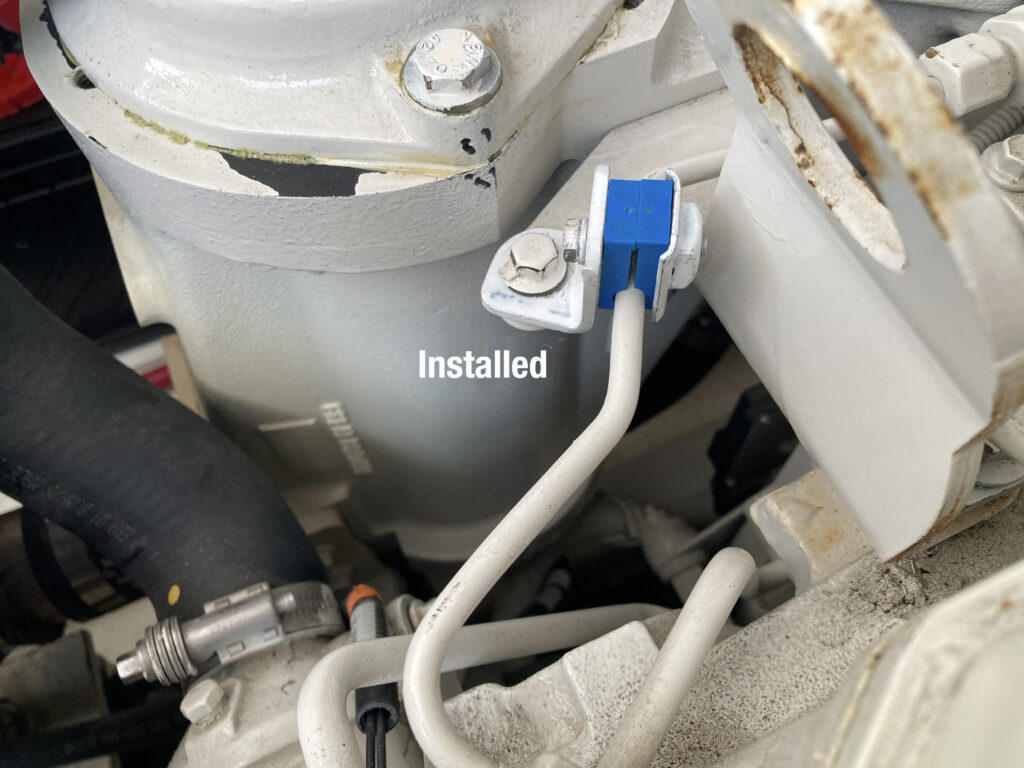
So, I went home to make the bracket over. This time I had an even better idea of what was needed and modified the original plan for a better fit. I slotted the holes to allow for adjustments when installing and sanded and painted it again. I went out the next day and installed it, and I believe it worked well! When it warms up enough I will do some touch up painting on the engines to keep them looking good.
While the weather is still on the colder side I have more work I can do. I have to get that oil pressure sensor installed on the starboard engine. Then a little more wiring at the helm and it’s on to working outside the hull. The two exhaust pipes that go through the transom appear to have some delamination happening. So that is number one on the hit list. Then install new anodes, paint the bottom, wax the hull and in we go!
I would like to take a moment and thank a reader who contacted me through the editor a couple of times. Tony is also an ex Coastie and we have talked at length about our experiences in the service and small boats in particular. Tony has a wealth of knowledge about the forty-foot small boats used for many years in the Coast Guard.
Always good to reminisce about the good times we had, Semper Paratus Tony.