In July of 1773, 189 Scot immigrants boarded the three-masted, square-rigged ship Hector, bound for Nova Scotia. Built in the Netherlands, the Hector had operated as a cargo ship for some 20 years before being converted into a transport vessel. Already nearing the end of its useful life, the ship was progressively rotting away during its 11-week crossing. By the time it arrived at Pictou Harbor, Nova Scotia, 18 of the passengers had succumbed to disease but a child had come into the world.
Like other sailing vessels of its time, the Hector used rocks ballast to stabilize it in rough waters. Typically, after arriving at port, a ship’s excess ballast was dumped overboard or along the shoreline. In North Carolina, underwater mounds of ballast stones were building up and obstructing approaches to coastal harbors. In response, the state’s General Assembly passed the 1784 act prohibiting disposal of ballast in the channels. However, along with the rocks loaded at a distant harbor and dumped overboard at the next port, came a variety of unwelcomed immigrants, marine and land-based invasive species.
One of the earliest alien immigrant species introduced to our coast, the common periwinkle snail (= winkle), Littorina littorea, was first detected at Pictou, Nova Scotia, in 1840. In England and at other European sites, the snail was an ancient food source. Was it intentionally transported to North America as a consumable or was it accidently introduced mixed, in with stone ballast? The jury is still out.
About a decade after first being sighted at Pictou, it was found on Nova Scotia’s North Atlantic shoreline, at Halifax. Aided by southern-flowing currents, its new home was the perfect location for launching an invasion of New England and the Mid-Atlantic states. During reproduction, the female releases tiny floating egg capsules that are carried by the currents, each containing 2 to 9 eggs (the usual is 2-3eggs). Within a few days, the eggs hatch as snail larva (called veliger). Its edges are equipped with beating hair-like (ciliated) structures that aid swimming and feeding. Though it can control some of its motion, it is still at the mercy of the currents.
By 1888, some of the snails had established themselves on the shores of Cape May, NJ. During the late 1990s, mature snails were frequently found packed in with seaweed used to transport baitworms from Maine to San Francisco Bay. Though they were later found as far north as British Columbia, it is still unclear if the invasion will succeed as it did along the East Coast.
Beginning in the 1800s, solid ballast began to be replaced by water. Evidence of the discarded stone ballast is clearly evident in Savannah, GA. The source for its River Street, hand-laid cobblestone pavement originated from European and/or African ports as did some of the stone walls lining the streets. The ballast stone waterfront building on West Bay Street was originally a warehouse for sugar and cotton. It now serves as the Chart House Seafood Restaurant.
The switch to water ballast created a surge of invasive species. The liquid is a perfect medium for transporting and spreading a wide variety of foreign plants, marine life and fresh water organisms. Some of today’s larger ships hold millions of gallons in their ballast water tanks. It has been estimated that “7,000 species are carried around the world …every day.”
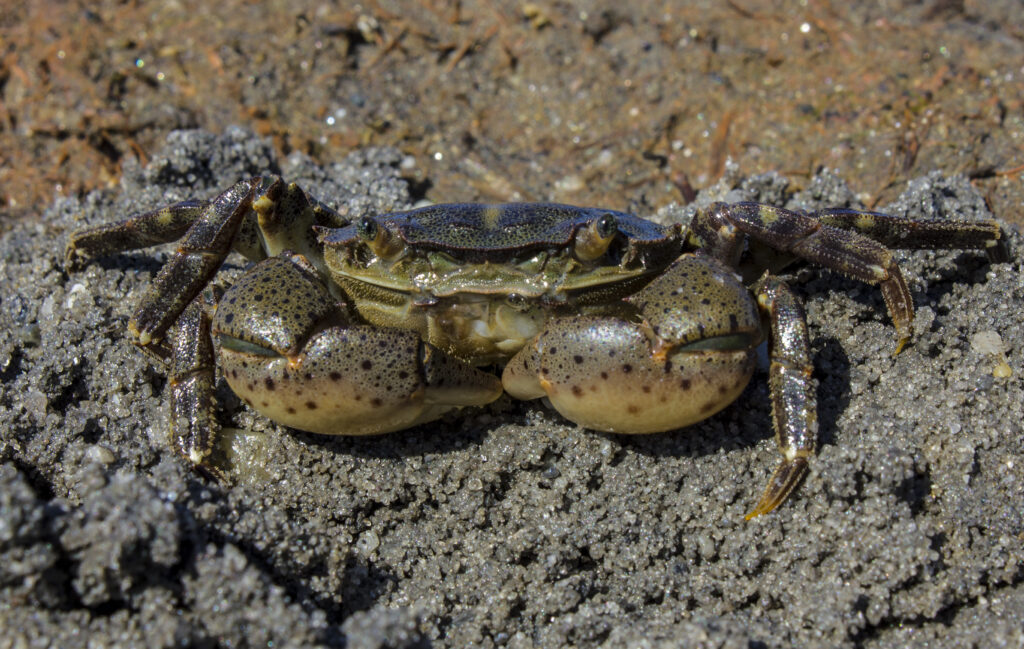
Native to the European and North African coasts, the green crab (Carcinus maenas) was first sighted on the Massachusetts shoreline in 1817. By the early 1900s, it had spread northward and during the 1950s, it is believed to have contributed to the severe decline in Maine’s population of soft-shell clams. It can dig down six inches in quest of a clam. It “can consume 40 half-inch clams per day.” The crab has had a dramatic impact on other native species, including small oysters and smaller sized crabs. It was soon reported on the marshes and shores of Nova Scotia to Virginia, later becoming the world’s most widely distributed invasine crab.
Other impacts created by invasive plants and animals include decrease in available habitat for native species, competition for food resources, decrease in water quality, cross-mating causing genetic dilution, introduction of parasites and disease carried by the alien and cost of control (“invasive species cost the U.S. more than $120 billion per year”).
In 2005, the US Fish and Wildlife Service identified a total of 91 invasive species in Long Island Sound. These ranged from alien sponge, barnacles, anemones, seaweed, marsh plants and a host of other foreign immigrants. One of the more recent obvious arrivals is the Asian shore crab (Hemigrapus sanguineus). In the Sound, it was first discovered at Rye, NY, in 1994. A native of China, Korea, Japan and Russia, the crab is now common from Maine to North Carolina. In its presence, there has been a decline in Atlantic rock crabs, spider crabs and the non-native green crab. But one alien least likely to succeed in the Sound is the lionfish. Between 2001 to October 2003, 11 juvenile lionfish were captured in lobster pots at the eastern end of Long Island Sound. Luckily, these waters are too cold for the fish to survive through the winter.
First sighted in 1985 at Dania Beach FL, south of Fort Lauderdale, the lionfish may have been deliberately released from a private collection or less likely, transported in ballast water. Several of the fish were apparently introduced during Hurricane Andrew when a private aquarium was flooded. In January 2018, Florida spearfishing scuba divers were enlisted in a lionfish-killing contest. Similar tactics have been employed for ridding the state of its most famous alien immigrant, the 17-foot Burmese python. Since 2002, more than 2,000 pythons have been removed from the Everglades. Still, it is estimated that “tens of thousands” remain in the National Park.
On 21 June 2012, the U.S. Coast Guard issued a new set of regulations for the discharge of ballast waters. The rules depend on the ship’s size and when it was constructed. Fines of $35,000 per day as well as criminal sanctions can be applied for violations of the rules. The new regulations can be reviewed online under USGS Ballast Water Regulations.
Private citizens can also help prevent the invasion of alien immigrants by removing them from a site and/or reporting sighting of any new alien species. Not-native pet amphibians, reptiles, fish and any other creatures including plants must not be released into the environment. Marine or fresh water weeds should also not be set free in the wild. To prevent aquatic hitchhikers, boats and boat trailers that are used between different bodies of water should be clean-dried. Unused live bait and the seaweed or other materials in which they are packed for transportation, should be disposed of in the trash.