Months before the collision on July 25th, 1958, between the super luxury Italian Line cruise ship SS Andea Doria and the cruise ship SS Stockholm, I had the good fortune to attend a bon voyage party for Monsignor John Flemming who had been summoned to the Vatican to head the North American College. The visit afforded me the opportunity to explore the beautifully decorated liner. Unlike other modern ships I had visited like the SS United States, the SS Andrea Doris was decorated in a kind of Renaissance design. The ship was described as floating art gallery. The theme was created to showcase the post war Italian prestige. I remember being breath taking. The sculpted glass, intricate woodwork, ceramic sculptures, and specialized lighting fixtures and art were equal decoration you might find in a Renaissance palace. Sadly, now the once majestic ship is resting on the ocean floor visited now only by inquisitive fish and the occasional scuba diver.
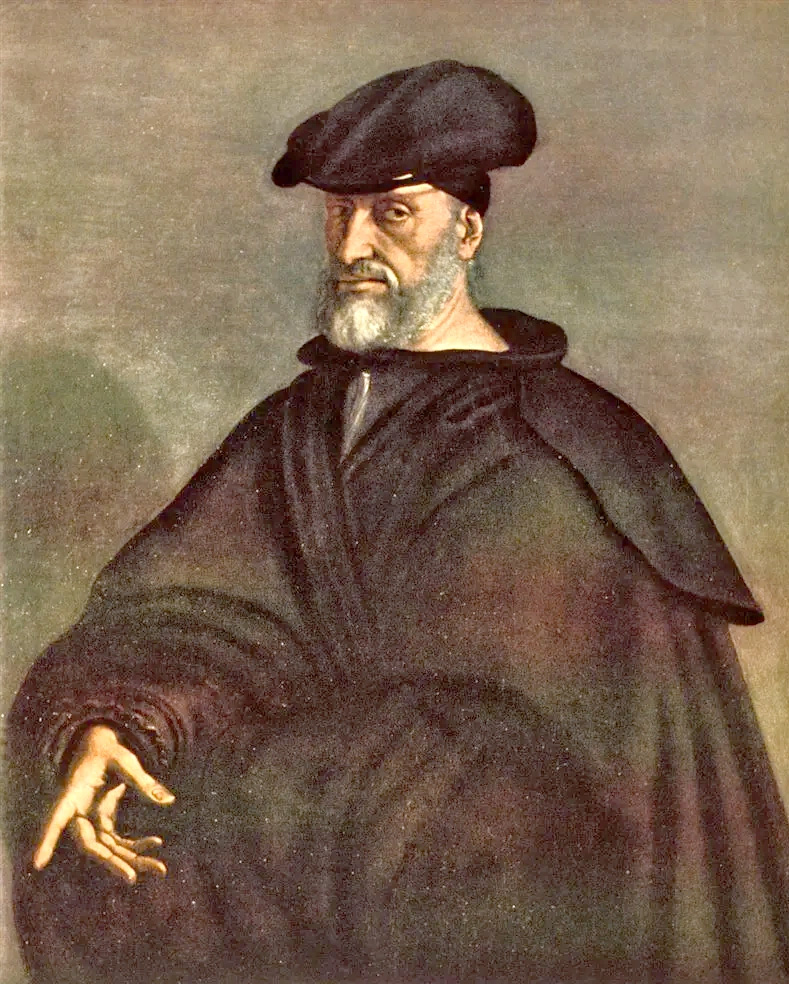
Oddly enough, I never thought of questioning the name of the ship.? Until on a trip to Italy, I came upon a statue of Admiral Andrea Doria in Genoa. Then another in Carra, Italy, one in Lithuania and then a majestic portrait at National Museum of Genoa -Royal Palace. So, who was this revered naval hero, famous enough to have many statues, portraits and a ship named in his honor.
Andrea Doria came into this world on November 30, 1466, in Oneglia, Province of Imperia, Liguria, Italy. He was the son of a wealthy noble family at a time when Italy was changing rapidly. The Duchy of Milan was ruled by two different Dukes of the Sforza family. Francesco I. Sforza ruled until his death on March 8, 1466. He was immediately succeeded by his son, Galeazzo Maria Sforza who took over on March 8, 1466. There were numerous squabbles among rival families in a toxic political climate. Andrea Doria’s dad died when the boy was just 6 years old. His mother died when he was 18 years old. He was adopted and raised by his uncle Nicola Doria, who was then Captain of the Papal Guard for Pope Innocent VIII. Nicola Doria invited the young Andrea Doria, to become a member of that elite group. Young Andrea served 8 years guarding the pope.
Andrea Doris was enamored by military service and joined a group of Private Military Contractors who as, mercenaries worked for any country willing to pay for their service. King Ferdinand I and his son Alfonso II of Naples, Italy as well as a several Italian princes hired Andrea Doria to defend their various holding. When the Corsican revolt against Genoan rule ensued in 1503, he fought with his uncle Domenico to quell the revolt. He rose to general then after spending half of his life as a land general, he decided to go to sea. Andrea Doria had had previous maritime experience when for time he managed a fleet of his uncle’s ships.
Andrea Doria quickly made his mark in naval combat as a brilliant commander and rose to the rank of Admiral. He outfitted eight galleys (ships) which he used to patrol the Mediterranean in search of Ottoman Turks and the legendary Barbary pirates who menaced shipping and shore-based homes and businesses. He gained both a reputation as a brilliant naval commander and a fortune in captured booty. His victory over the Turks at Pianosa (Pianosa is an island in the Tuscan Archipelago in the Tyrrhenian Sea, Italy} in 2519 gained him hero status.
The army of the Holy Roman emperor Charles V conquered Genora in 1522, thereby removing the pro-French faction in the city. Initially, Andea Doris joined Francis, the King of France in the fight against Charles V as admiral of the French Mediterranean fleet. The French were defeated at Pavia 1525 at which time King Francis was taken prisoner by French imperial forces. When King Francis was set free in 1527, Andrea Doria once again served King Frances in the capture of his beloved Genoa by imperial forces.
It was not long before Andrea Doria became disillusioned with the way King Frances was administering Genoa and the treatment he was receiving from the French. Andrea switched his allegiance to back Charles V and fought on the Imperial side. An extremely grateful Charles V named Andrea Doria grand admiral of the imperial fleet and prince of Melfi. With the many honors granted there was also vast sums of money as is evidenced by Andrea Dorias palatial home. As the ruler of Genoa, he disposed of various waring factions that were crimpling the city and formed a new government composed of the city’s principal aristocratic families.
Aa a leader he got the foreign forces out of Genoa in 1528. The eternally grateful Charles V named Adrea Doria grand admiral of the imperial fleet and prince of Melfi. With the many honors granted to the Admiral there was also vast monetary rewards as is evidence by Andrea Doria’s the palatial home. As the ruler of Genoa Andrea Doria disposed of the various factions that were crimpling the city. He formed a new government composed of the city’s principle aristocratic families, an oligarchy to be sure.
At an age when most men retired, Andrea Doria commanded several major battles once again for Charles V. He fought with the Turks and the helped capture Tunis in 1535. Even at the ripe old age of 84 the Admiral persuade the Barbary Pirates. When a new war broke out between France and Spain, he fought the French, who had seized Corsica. He retired to Genoa in 1555, passing command of his fleet to his grandnephew Giovanni Andrea Doria. Andrea Doris died on November 25, 1550, at the age of 94.
Andrea Doria is revered as a great hero and immortalized marble and on canvas in recognition of his relentless pursuit of the enemy and brilliant tactics. He was devoted to his home city of Genoa which he recused from foreign powers and created system of government that was effective and stable. However, the Admiral was no saint. He was said to be greedy, conceited, vindictive, unscrupulous, cruel and authoritarian.