
A shipwright, as defined by Merriam-Webster’s dictionary, is ”a skilled carpenter specializing in building and repairing ships, essentially a builder of vessels, stemming from Old English words for ship and worker (wright).” Anyone who has spent some time around a working shipwright cannot help but be awestruck by the things they do and the inherent ingenuity these craftsmen possess. In the days of sail, the ship’s carpenter was called upon to make barrels, repair damage to the hull from rocks, barnacles and worms, repair the damage done by cannon balls fired from attacking ship and just about anything that involved wood on a ship. While not an officer on commercial ships, the ship’s carpenter held a high position and often had his own stateroom.
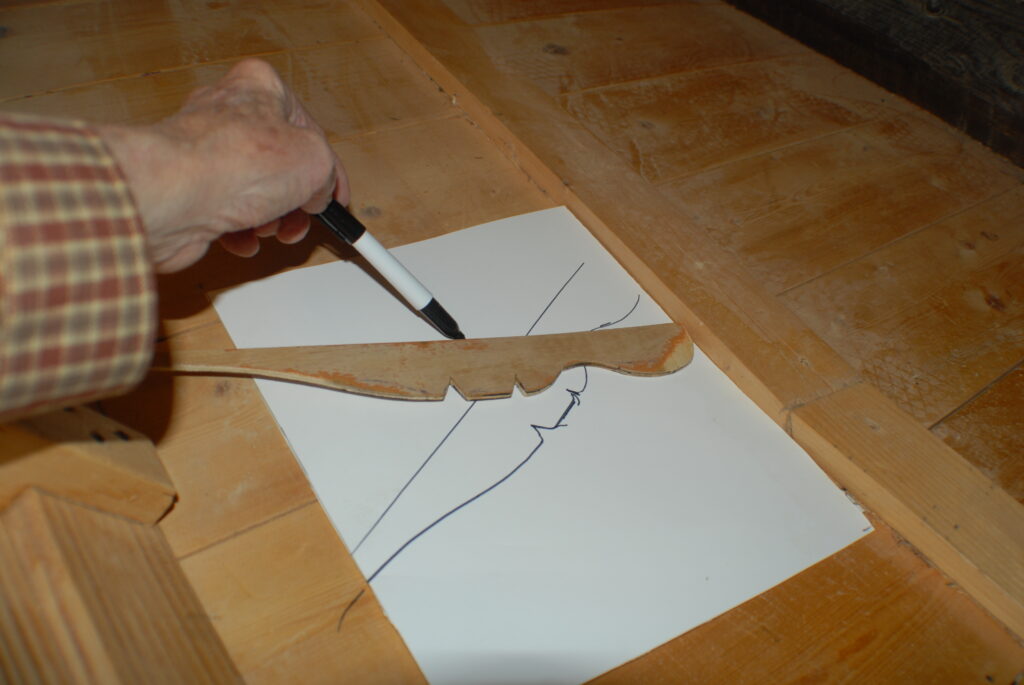
On land, the shipwright was the man who converted the half model shape of a ship into a full-sized vessel. To create a vessel, the shipwright used a variety of special tools to construct the curves and angles called for by the ship’s architect. One of those tools is a “tick stick.” It is an evolution of what shipwrights called a “Joggle stick.” No one is credited for its invention; it has been around so long that its history seems to be lost in time. It is an ancient technology that seems to have existed before modern measuring standards were recorded. Essentially, the tick stick is an easy-to-make device for accurately measuring curved or irregular shapes.
Let’s say you are making a panel to fit into the hull of a deadrise boat to be attached to a rib frame. It is a complex curve that may have cutouts for stringers. The idea is to have a tool that will enable you to mark a sheet of paper or a marking board, which will create a template once you connect the dots. Old-time shipwrights generally made their own wobble or tick sticks depending on the dimensions of the project. One of the great things about the tick stick is that it can be made in any size, from one suitable for a canoe to one that works well on a 300 ft sailing ship of the line.
They are easy to make out of a piece of ¼ inch plywood or even a paint stirrer. The important thing is that there is one flat edge, a notch or two, a point and a pencil. You will also need a pencil. It took about ten minutes to cut out the tick stick shown here. I used my Tick Stick to measure the angles on a mockup of a deadrise boat at the Deltaville Maritime Museum in Virginia.
Once you have marked the lines on the cardboard (tally board), the next step is to transfer those marks to a template or the actual new board you are shaping. Place the stick on your tally board, then place that on the new board. Mark a dot at the tip of the stick for each measurement taken. Make as many marks as needed to accurately duplicate the shape you need. The rest is just a matter of connecting the dots. Make a template, cut it out and mark the board. In my limited experience, I found it easier to mark and cut the board I needed.
Especially on board a vessel, ship carpenters have to rely on their ability to innovate and improvise. Merike Joosep, writing online in Ancient Marvels of Mankind, wrote, “In 1936, a wooden chest that once had belonged to a Viking craftsman was found at the bottom of the former lake Mästermyr on the island of Gotland (Sweden), which now had turned into a bog. There were axes, hammers, tongs, punches, plate shears, saw blades, files, rasps, drills, chisels, knives, awls and whetstones among the 200 objects that were found in the chest. The chest also included raw material and scrap iron as well as finished objects such as locks, keys, a frying pan, cauldrons and bells. The amazing thing is that the tools are at least 1000 years old, but they look like they could have been made yesterday. They are of the same materials, have the same shapes and the same functions as modern tools.
The chest, 90 cm (35 in) long, 26 cm (10 in) wide and 24 cm (9.4 in) high, was made of oak with iron hinges and a lock. A chain, made up of 26 figure-of-eight-shaped links, was wrapped around it. It served both as an extra lock and a handle since the chest was too heavy for the original handle.
Given the wide range of tools and objects in varying styles in the find, and the lack of coins or other chronological markers, it has been impossible to determine an exact date for the chest. The wider term ‘Viking Age,’ around 1000, is used for dating it. The chest had probably been placed in a boat that capsized and sank in the lake. The contents of the chest indicate that it belonged to a travelling craftsman who made repairs and produced new items. The tools show that he was a smith and a carpenter, and had some knowledge of locks, coppersmithing and coopering.”
Imagine if a similar toolbox from an ancient Japanese carpenter could be found. It would most likely contain ancient Japanese carpenter’s measuring tools like the Sahagian (L-shaped square ruler for layouts, angles, and calculations), Kebiki (marking gauges for fine lines), and the Sumitsubo (ink pot with a silk line for snap lines), all used with a bamboo marking pen (Sumisashi) and traditionally marked in units like sun and bu (around 30.3mm per sun). Having these tools at hand enabled Japanese carpenters’ work to be incredibly precise.
The wooden objects found in Egyptian tombs proved that there were skilled carpenters present. Those men who created the wooden carving of Pharos were marvelously skilled. The relied on, simple tools for measurement like the Cubid (a standard length, often Royal Cubit), knotted ropes for longer distances, the Plumb Bob for vertical lines, and the Builder’s Square (or “A”-frame level) for right angles and leveling, using concepts of fingers, palms, and spans for smaller divisions, enabling remarkable precision in their woodworking and monumental construction.
It is very possible these ancient carpenters had a ticking stick in their toolboxes and used it so often that it became so routine as to be taken completely for granted. At any rate, it is a good tool to have.
See informative videos online at;
https://www.youtube.com/watch?v=Cd2LY857oTY https://www.youtube.com/watch?v=bQzl8lnjYxg