
At the end of a breakwater in Waukegan, Illinois, there is an automated light that shines from an iron cylinder, the remains of what was once a light station in Lake Michigan. Three different lighthouses served this midwestern port. In 1847, a small brick structure was built, and a second, wooden residence and tower was built in 1860, as the nation was descending into political chaos leading to the Civil War.
The station’s well-known keeper was one-armed Civil War veteran John Williams. He received his appointment from Abraham Lincoln in March of 1865. Williams lost his arm at the Battle of Gettysburg. He remained faithful to his position. He had a wife, Helen and had seven children. He tended the station till he passed away in February 1892.
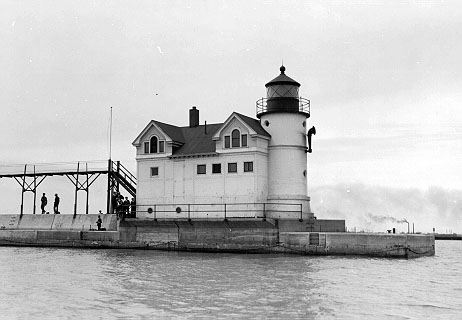
The Civil-War-Era lighthouse was replaced with a new one. It was built at the end of the harbor’s long breakwater. The lighthouse served well until 1967 when a fire gutted the building. Later, the Coast Guard cleared the ruins; only part of the tower remained.
In 1846, Illinois Congressman John Wentworth presented to the citizens of the State of Illinois, a petition for an appropriation to construct a harbor and lighthouse at “Little Fort” on Lake Michigan. Congress appropriated $4000 for the light, then two years later added a brick tower thirty-five feet tall along with a six-room, one -and- a-half-story keeper’s area. Truman Hibbard was hired in 1849 and became the first keeper. Eight lamps, fourteen-inch reflectors, were used in the lantern room in 1851. A sixth-order Fresnel lens was installed in 1858.
In 1852, Congress appropriated $15,000 for harbor improvements, which included a breakwater to protect the piers in the harbor. In 1854, Congress gave $10,500 for a permanent foundation pier close to the breakwater to be topped with a light. A crib, thirty feet by twenty-five feet, was placed in position to form the breakwater, however, a storm carried it away, so, the project was halted. Because of this, the lighthouse board began to make improvements to the old 1849 lighthouse. In 1860, a wooden tower was built on top of the keeper’s dwelling, as well as an octagonal cast-iron lantern. In 1868, new outbuildings were added to the station. The tower was repainted in 1880.
In February 1892, John C. Williams had written to the inspector to let him know of his father’s passing. He performed the duties until a new keeper was appointed.
In April 1892, George Larsen was made keeper of the light. The metalwork for a permanent tower was shipped to Waukegan by Russell Wheel and Foundry Co. of Detroit in June 1899. Also, a fourth-order lantern room from the lighthouse depot. In 1899, a concrete foundation was built, and the metal tower was erected with a fourth-order Henry-LePaute Fresnel lens, which shone white for twenty seconds, followed by four red flashes, with intervals of five seconds. An elevated walk was added that was 400 feet long, built on a pier with a lifeline for the keeper. Here, 1,075 feet of galvanized wire rope, forty-five wrought iron posts were placed. On June 20, 1899, the former lighthouse was sold at an auction to the city of Waukegan.
In 1902, the River and Harbor Appropriation Act made efforts to improve the harbor by dredging to a depth of twenty-one feet at Waukegan. The lighthouse board wanted $10,000 to have a light and fog signal to mark the new work. In 1905, a relocation was made for the metal tower to mark the outer end of the south pier that was extended 1,400 feet. In 1902, after serving as an assistant keeper at Wind Point, lighthouse keeper Frederick Rether was promoted to head keeper. In December 1907, he slipped on an icy pier and fell into the cold water surrounding the lighthouse. His body was found just over a year later in the waters of Lake Michigan. Joseph A. French was the officer-in-charge of the Waukegan Harbor lighthouse from 1966-1969. Daniel J. Gengler served under him till the end of April, and Stephen J. Schneider took over. He served until Sept 1969, when the station was decommissioned. Today, the keeper’s dwelling remains on the corner of Madison St. and Harbor Place, which is a deli and a bait and tackle shop. In 2009, the Army Corps of Engineers did a renovation of the lighthouse pier.
Fresnel Lens: A Thin and lightweight lens that uses a series of concentric prisms rather than a continuous curved surface to focus, magnify, or collimate light.
Breakwater: A permanent offshore or coastal structure, made of stone, concrete or rubble-mound to protect a harbor.