The ship was a wooden-hulled three-masted ship. It was the first that the U.S. Navy commissioned. It was originally a 90-gun ship. In 1836, the ship was cut down to one deck and was re-rated as a 54-gun frigate. (Frigate: A vessel featuring three masts and square rigging.)
She was launched at the Boston Navy Yard on June 22, 1814. The ship took on guns and stationed along with the frigate USS Constitution in Boston. She didn’t cruise until the end of the War of 1812. The ship had been blocked in port by a British squadron, along with 74 gunships and a 98-gun HMS Boyne. She led her squadron from Boston on July 3rd, 1815 to deal with the piratical problems of the Barbary states against American merchant commerce. The ship was under the command of Commodore William Brainbridge and Captain William M. Crane. Peace was established by a squadron by Stephen Decatur at the time of American Independence in the Mediterranean. She showed American naval strength before the Barbary ports whereby encouraged them to maintain peace treaties. Independence arrived back in Newport, Rhode Island on November 15, 1815. On November 29th, 1819 she was the flagship (Flagship: A naval vessel that carried the flag of an admiral, distinguishing it from other ships in a fleet.) of Commodore John Shaw until being placed in ordinary (Ordinary: Those that were no longer required for active service) in 1822. The Independence stayed in ordinary at Boston until 1836, when she was cut down to one covered fighting deck with poop and forecastle. (Poop and Forecastle: Where the mates had their quarters, sometimes below, freeing up more of the hold for cargo.)
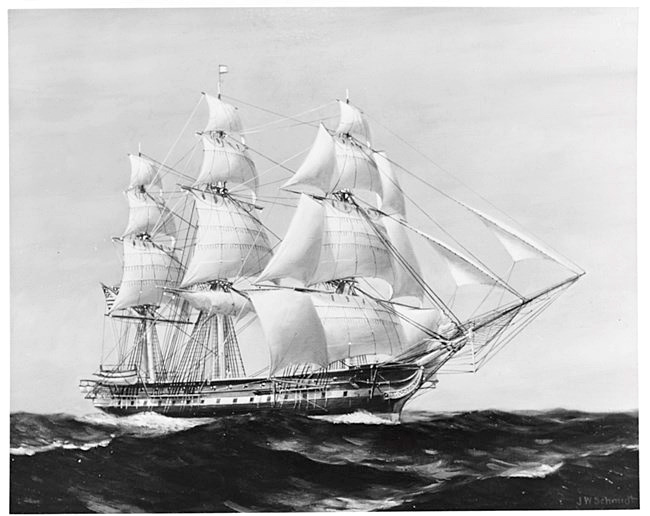
She became a very large frigate as she was rated down to 54 guns, proving to be one of the fastest and most powerful frigates of the navy. Independence was recommissioned on March 26th, 1837 sailing from Boston, as a flagship of Commodore John B. Nicholson. An on-board passenger was Honorable George Dallas, who was minister to Russia. Later, Independence proceeded to Kronstadt on the 29th of July 1837, and received a visit from Emperor Nicholas I of Russia. Independence departed from Kronstadt for Rio De Janeiro on August 13, 1837. There, she became flagship of the Brazil Squadron to guard American commerce on the eastern seaboard of South America.
In 1839, Commodore Nicholson attempted to end the war between France and Argentina. He stated:
“I volunteered, as I conceived it a duty I owed to my country, as well as to all neutrals, to endeavor to get peace restored, that commerce should be allowed to take its usual course in accordance with the feelings of humanity. At least, I hope my endeavors will be approved by the department. I see no probable termination of this war and blockade, which is so injurious to the commerce of all neutrals.”
The Independence returned to New York on March 30, 1840. She stayed in ordinary until May 14th, 1842. Then she became the flagship of Commodore Charles Stewart of the home squadron. It was based in Boston and New York. The ship continued as his flagship until laid up in ordinary on December 3rd, 1845. The ship recommissioned on August 4, 1846 while the nation was at war with Mexico.
She became the flagship of Commodore William Shubrick, commander of the Pacific Squadron. The Independence had assisted in blockading the Mexican coast and captured the Mexican ship Correo on May 16th,1847. She landed sailors and marines to occupy Mazatlán on November 11th, 1847.
Later, she cruised to Hawaii and arrived in Hilo on August 12, 1848 and visited Lahaina and Honolulu. Later, she returned to the East Coast at Norfolk, Virginia on May 23rd, 1849. There she was decommissioned on the 30th.
The Mediterranean Pacific. 1849-1912
Independence was recommissioned on July 7th, 1849, departing Norfolk on the 26th under Captain Thomas Conover, serving as flagship of the Mediterranean Squadron under Commodore Charles Morgan. First U.S. man-of-war to show its flag at Spezia,
Italy. She arrived on May 23rd, 1850 to a warm welcome. Later, returned to Norfolk on June 25th, 1852 and placed in ordinary at New York on July 3rd, 1852.
Independence was once again recommissioned in September 1854, departing New York on October 10th to serve as a flagship of the Pacific Squadron under Commodore William Mervine. Arrived at Valparaiso, Chile on February 2nd, 1855. She cruised on northward to San Francisco, then west to Hawaii. Proceeded from Panama Bay, then entered the Mare Island Navy Yard on October 2nd, 1857, serving as a receiving ship until she was decommissioned on November 3rd, 1912. Her name was removed from the Navy list on September 3rd, 1913.
On November 28th, 1914 she was sold to John H. Rinder and towed to the Union Iron Works, San Francisco, then to Hunters Point. A few repairs were made and a plan was also made to use the ship as a restaurant for the Panama-Pacific International Exposition. The plan was not executed. Pig iron and the ballast were taken from her hold and hard wood taken from the orlop deck knees. (Orlop Deck: Refers to the lowest deck of a ship above the hold and typically below the waterline.) On September 20th, 1915, Independence was burned on the Hunters Point mud flats for recovery of metal fittings.
General Characteristics:
Type: Ship of the line
Tonnage: 2243
Length: 190ft 9 in
Beam: 54ft 7 in
Draft: 21ft 3 in
Propulsion: sail
Complement: 790 officers and enlisted
Armament: 90 x 32-pounder guns