I’ve always been fascinated with legends like the Flying Dutchman or ghost ships covered with slime that would ensnare unwary sailors. At one time, a lot of derelict vessels, while not necessarily haunted by ghosts, could still kill unsuspecting mariners.
At the end of the nineteenth century, in the waning days of sail, the North Atlantic Ocean was literally strewn with derelict vessels. These derelicts were a hazard to navigation and a vessel striking one led to many ships being severely damaged or even sunk. According to some estimates, in 1893, there were reports of 418 different derelict vessels and 106 were identified by name.
These abandoned vessels were primarily wooden sailing vessels. Hundreds of reported sightings provided enough information that, for the first time, ocean currents could be tracked. In 1883, the U.S. Navy Hydrographic Office began printing monthly pilot charts of the North Atlantic that showed the reported positions of derelict vessels and other hazards to navigation. These charts were distributed for free to navigators in return for information on weather and any sightings.
Most derelicts sank within 30 days, but many managed to stay afloat much longer. The longest surviving derelict vessels were often wooden lumber schooners because of the inherent buoyancy of their wooden cargo. One of the longest-lived derelicts was the wreck of the lumber schooner Governor Parr. The Governor Parr was the last four-masted schooner built in Parrsboro, Nova Scotia, in 1918. W.R. Huntley & Sons for Archie Davidson and Captain Angus D. Richards built this handsome 916-ton vessel.
On October 3, 1923 the Governor Parr, carrying one million board feet of lumber from Nova Scotia to Buenos Aires, Argentina, ran into a heavy gale. During the storm, she lost two sails, her mizzen and spanker. Captain Angus Richards and one seaman were lost during the storm. With no captain, damaged, and heavily laden, the crew panicked and abandoned ship. They launched a lifeboat and were rescued later by the S.S. Schodack. Everyone assumed the Governor Parr had sunk, but 5 days later, she was spotted still floating.
The damage to the Governor Parr was significant, but the 200-foot-long schooner was extremely well constructed and she remained afloat and drifted throughout the Atlantic. Several attempts were made to either destroy or tow her to shore, but they all failed. On January 1, 1924, the American Coast Guard’s USCGC Tampa attempted to tow the schooner to Halifax, Nova Scotia, but the Parr broke loose the next day in a heavy gale. The Tampa had to give up this attempt to return to shore to refuel.
After her abandonment, Governor Parr was sighted many times over the years but somehow managed to remain afloat, an incredibly dangerous hazard to navigation. She drifted over large portions of the Atlantic Ocean and was sighted as far south as the Canary Islands. The final fate of Governor Parr remains unknown.
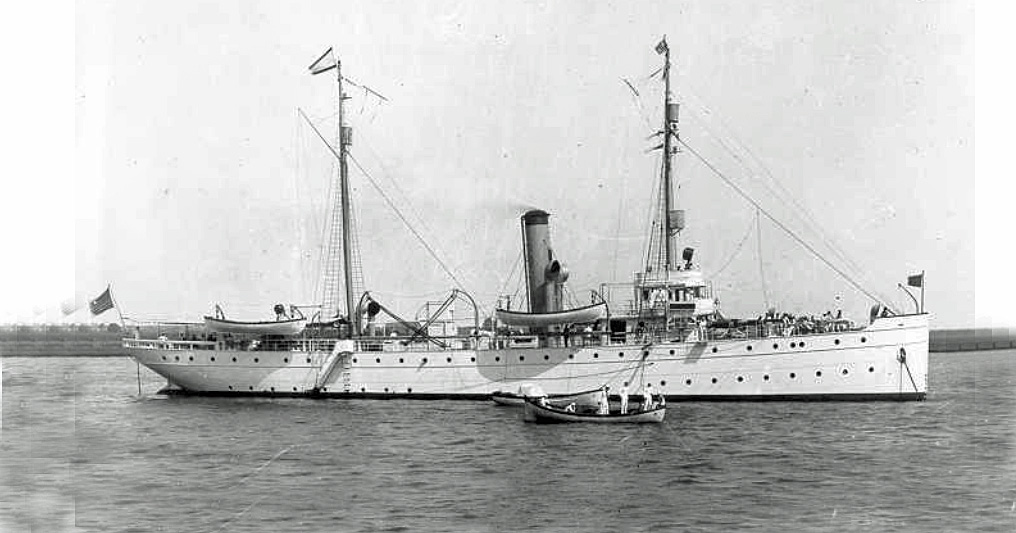
The danger from these derelict vessels was so great that in 1908, the U.S. Revenue Service launched a vessel purposely built as a derelict destroyer, the USCGC Seneca. The Seneca featured a seaworthy hull, a long cruising range, good towing capabilities, and a large munitions storage to be used for blowing up wrecks. Her principal dimensions were 204 ft long, 34 ft beam, 17 ft depth, and 1,259 tons displacement. Her maximum speed was 11.2 knots and she carried a crew of 9 officers and 65 enlisted men.
Her primary operations area was the North Atlantic, but her missions were later expanded to include international ice patrols and convoy escort duty during World War I. She was one of 5 Coast Guard cutters serving with the U.S. Navy in European waters during World War I.
In her first year of service, the Seneca successfully destroyed 11 good-sized obstructions. She also assisted in the rescue of the of the crew of the White Star Line’s SS Republic after a collision with the Lloyd Italiano liner SS Florida 26 miles southeast of Nantucket.
The Seneca’s mission changed after the RMS Titanic struck an iceberg on April 1912 with the loss of 1,517 lives (other casualty numbers are much higher). This disaster raised the demand for ice patrols to warn ships of the presence of icebergs. The duty was turned over in 1913 to the Revenue Cutter Service and the Seneca became the first cutter to assume ice patrol duties based out of Halifax, Nova Scotia.
On September 16, 1913 the Seneca towed the derelict vessel Lottie Russell into Halifax and continued her ice patrol duties, rescuing 4 survivors from a lifeboat from the freighter Columbian. The lifeboat had been drifting in the North Atlantic for 10 days. Originally, 14 survivors had put to sea in this boat, but 10 had died of hunger, thirst, and exposure.
In April 1917, the U. S. declared war on Germany and Coast Guard Cutters were transferred to the U. S. Navy. Seneca, along with the cutters Tampa, Ossipee, Algonquin, and Manning, made up Squadron 2 of Division 6 of the Atlantic Fleet Patrol Forces. Their mission was to protect convoys from submarine attacks. During the war, Seneca escorted 19 convoys comprising a total of 350 vessels through the sub-infested waters between Gibraltar and Great Britain.