William Lyall had thoroughly enjoyed his day walking along the Atlantic City, New Jersey Boardwalk and taking in the sights and sounds of the seaside resort. As the hands of the clock approached eleven o’clock in the evening, he opened the window of his eighth-floor hotel room to take in the fresh ocean breeze, turned off the lights, and then retired to his bed to get some rest. As he lay under the covers he heard something fluttering by the window. At first, he dismissed the noise as something from the Boardwalk below. Then, as he lay there, he heard some whirring that sounded as if it was coming from inside the room. William pulled back the covers, swung his legs over the edge of the bed, slid on his slippers, and quickly turned on the lights. The source of the sounds was then discovered on the floor of the hotel room. A blue-and-white pigeon lay on the floor and looked terribly exhausted. Lyall went to his wardrobe and quickly grabbed and donned his robe. He then returned to the feebly whirring pigeon and gingerly picked him up. Feeling sorry for the tired bird, he wanted to ensure that it was safely provided a return to nature via one of the hotel’s bellboys.
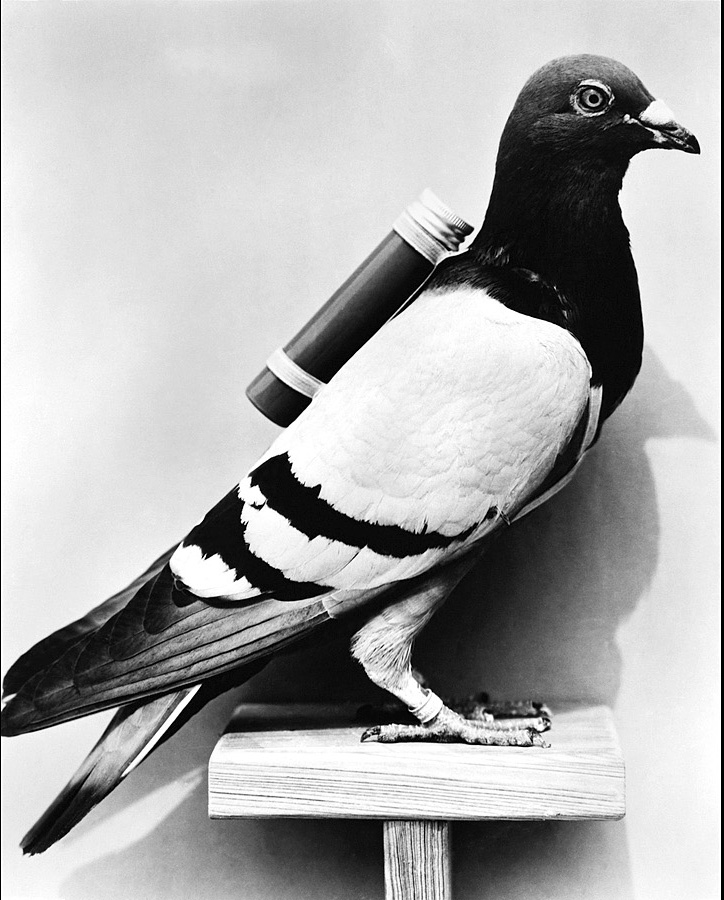
Mr. Lyall arrived in the lobby of the Marlborough-Blenheim Hotel and a bellboy was quickly summoned to assist him and his unexpected nightly visitor. As Mr. Lyall returned to his room, the bellboy was holding the pigeon and discussing the odd incident with the hotel’s night clerk. As the bellboy continued to tell the story, two other guests that were burning the midnight oil in the lobby, listened intently to the oddity. Joseph Buffington, a United States Circuit Court Judge and his cousin, Lieutenant Matthew Taylor, United States Navy aviator, wandered over from their leather seats to take a look at the tired pigeon. Suddenly Lieutenant Taylor made an interesting observation.Lieutenant Taylor asked the bellboy to hold up the pigeon so that he could take a closer look. With his cousin, the bellboy, and the night clerk looking on, Lieutenant Taylor pointed out the small aluminum cylinder fastened to one of the pigeon’s legs. The lieutenant carefully opened the cylinder and slid out the small message. “Down ten miles west of submarine chaser at 4:15 P.M. No gas. Ensign Finch.” Lieutenant Taylor turned to the night clerk. “Get the operator on the phone. We need to get through to the Fourth Naval District at Philadelphia.” Lieutenant Taylor, formerly the commander of forces afloat in the Sixth Naval District, knew that time was of the essence. Lieutenant Taylor grabbed the phone and quickly explained the circumstances of the situation. As he hung up the phone a few moments later, the tired bird remained in the capable hands of the bellboy. “That bird,” the Lieutenant offered, “is no normal pigeon. He is a carrier pigeon. We used them during the war.”
The U.S. Navy had begun experimenting with carrier pigeons in the early 1890’s with the first pigeon loft set up in a boathouse at the United States Naval Academy by Professor Henri Marion. The first kit, a group of pigeons who had been trained as opposed to a flock of pigeons (amateurs, if you will), had been provided by the U.S. Army Signal Corps, which had abandoned its three years of experimentation with the use of carrier pigeons. Marion trained the kit to fly back and forth from the training ship U.S.S. Constellation to their home loft on the campus. Gradually increasing distances over time, eventually, the kit was routinely utilized to fly as far as 150 miles out at sea. The usefulness of the carrier pigeons was recognized, and by 1896 the U.S. Naval Pigeon Messenger Service had been established. Despite their proven worth during the Spanish-American War, the advent of radio technology in the maritime realms meant the end for the service by 1902. The U.S. Navy shelved the winged technology and auctioned off its kit of pigeons. But birds often return home to roost and during the Great World War, once again pigeons stepped up for their country both on America and on foreign soil, or in this case, foreign air. The U.S. Navy returned to the utilization of pigeons, established a pigeon trainer rating, and ensured that antisubmarine patrol aircraft were provided with these feathered naval aviators for the leather jacket donned aviators in case of emergency or radio silence situations. More than once, the carrier pigeons saved the lives of their fellow brethren, though human, flyers.
As Lieutenant Taylor continued to explain the usefulness of carrier pigeons, far out at sea, Ensign Howard Finch waited aboard his downed seaplane wondering if the pigeon had ever made landfall. The young naval aviator always loved the ocean but preferred to see it from above. Now, almost eight hours after being forced to make an emergency landing due to fuel issues, he was hoping that rescue would come sooner rather than later. He was cold, wet, and tired from his unplanned landing on the far expanses of the Atlantic Ocean somewhere between Cape May, where he had gone aloft from, and Atlantic City, New Jersey.
The phone calls to the Fourth Naval District in Philadelphia had sparked a flurry of activity across the wires. Radio operators at the League Island Navy Yard called upon the United States Naval Air Station at Cape May, New Jersey and within minutes, Coastguardsmen launched several auxiliary cutters to aid in the search. Already underway, submarine chasers were also given additional details from the carrier pigeon’s message and continued to scan the seas with their searchlights in search of the wayward and downed Ensign Finch.
By roughly midnight on April 7th, 1919, the searchlight of one of the submarine chasers finally spotted the downed seaplane. Ensign Finch waved at his rescuers and in short order, the crew pulled the tired, cold and wet aviator aboard where he was provided with a warm wool blanket and a cup of hot coffee. Roughly an hour later, the submarine chaser delivered the thankful ensign to the base. As he entered the ready room, word was quickly passed to him about the arrival of his carrier pigeon at the Marlborough-Blenheim Hotel. Ensign Finch grabbed the phone, “Give me Atlantic City,” he stammered excitedly, “the Marlborough-Blenheim quick!” he continued. As he waited for the operator to connect the call he continued to talk to his fellow aviators who had gathered to hear of his exploits and rescue.
“I had drifted eight miles or so,” he continued as he held the phone up to his ear awaiting the connection to be made. “I had to climb out of the cockpit a few times due to the high seas. It was raining like…” finally his attention turned from his fellow pilots and focused on the phone. “You’ve got a pigeon there, haven’t you?” he inquired. He listened intently. “It’s in good shape, hey?” he continued to question. He smiled. “Well, say, if you to do something for me, give that bird the biggest spread the hotel can stand!” The pigeon and his prayers had been answered. He was quite the lucky Finch after all.
The carrier pigeon was well fed and after an evening’s rest was on his way, via a train passenger bound on the afternoon trip for Cape May, New Jersey, thanks to Judge Joseph Buffington and Lieutenant Matthew Taylor who had expressed the significant importance of the feathered messenger.
The carrier pigeon program and its trained kit had proven successful once again. Ensign Finch, downed by issues with his seaplane’s fuel had been plucked from the bobbing Atlantic Ocean thanks to the tiny message stowed in the tiny aluminum cylinder on the carrier pigeon’s little hind limb. In an interesting turn of events, U.S. Navy Ensign Finch had been located and landed at his air station in Cape May, New Jersey, thanks to his fellow winged aviator and its successful mission of messenger mercy, ending his eight hour forced saltwater sojourn in our waters.