One of my favorite movies is The Caine Mutiny starring Humprey Bogart as Captain Queeg. The movie is based on a true story that novelist Herman Wouk used to depict the dramatic events surrounding Admiral Halsey and typhoon Cobra. The novel’s central theme reflects the real-life tension between upholding the chain of command in the Navy and preventing disaster.
Admiral William Frederick Halsey Jr. is one of only four men in American history to reach the rank of five-star Admiral of the Fleet. During World War II Halsey was nicknamed “Bull” by reporters and the public for his aggressive, tenacious, bulldog style and fiery demeanor, with the way he led his forces, “like a bull in a China shop.” Halsey reportedly disliked the nickname, but the name stuck. There is no doubt he was a brilliant commander and was instrumental in the U.S. success in the War. However, his bullheadedness may have led to a few questionable command decisions.
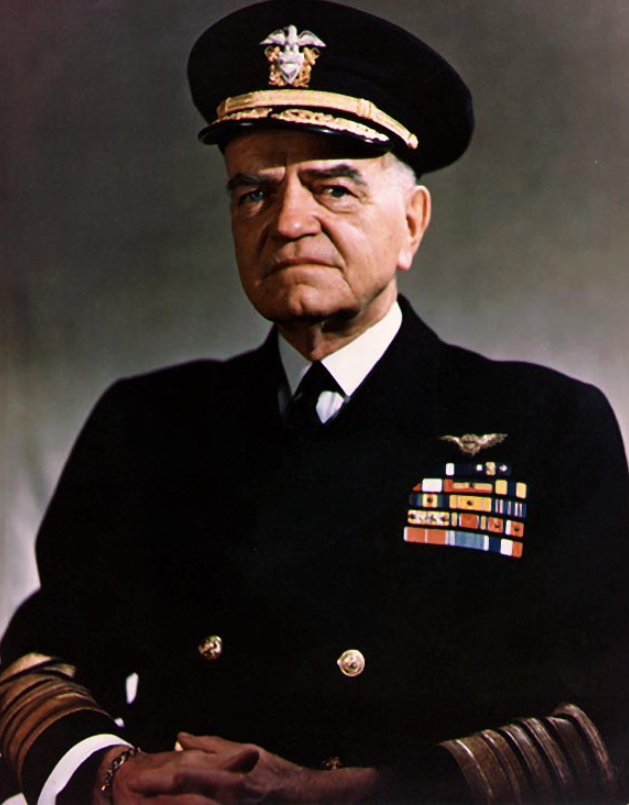
Born in Elizabeth, New Jersey in 1882, Halsey graduated from the United States Naval Academy in 1904. He served in the Great White Fleet and during World War I he commanded the destroyer U.S.S. Shaw. He was given command of the aircraft carrier U.S.S. Saratoga in 1935 after completing a course in naval aviation. He was promoted to the rank of rear admiral in 1938. At the start of the World War II Halsey commanded a task force led by the carrier U.S.S. Enterprise in a series of raids against Japanese targets.
Halsey was made commander of the South Pacific Area and led the Allied forces over the course of the Battle for Guadalcanal (1942–1943) and the Solomon Campaign (1942–1945). In 1943 he was made commander of the Third Fleet, the post he held through the rest of the war. He took part in the Battle of Leyte Gulf, the largest naval battle in history.
In December 1944 the Third Fleet was conducting refueling operations off the Philippines after the Battle of Leyte Gulf when the Navy’s weather service in Hawaii issued a storm warning. They predicted a typhoon was approaching the Fleet’s operating area. Rather than move the Third Fleet away, Halsey chose to remain on station for another day. In fairness, he received conflicting reports from Pearl Harbor and his staff. The Hawaiian weathermen predicted a northerly path which would have passed his Task Force by two hundred miles. However, his own staff predicted a path far closer to the mark with a westerly direction.
True to his aggressive nature Halsey played the odds, declining to cancel planned operations and requiring the ships of Third Fleet to hold formation. By the evening of December 17, the sea-state was so rough that the Third Fleet was unable to land its combat air patrol on the pitching and rolling decks of the carriers. All the aircraft were ditched in the ocean and lost; all the pilots were saved by accompanying destroyers.
The next morning the barometer on the battleship New Jersey, his flagship, was noted to be dropping precipitously. With increasingly heavy seas the fleet still attempted to maintain stations. The greatest threat was to the fleet’s destroyers which were running dangerously low on fuel. Finally, at 11:49 am, Halsey issued an order for the ships of the fleet to take the most comfortable course available to them. Many of the smaller ships had already been forced to do so.
Between 11:00 a.m. and 2:00 p.m. the typhoon was at its height with massive 70-foot seas and winds estimated to be over 83 knots. Halsey issued a typhoon warning to Fleet Weather Central. During this time many ships were severely damaged, and three destroyers were capsized and sank. One hundred forty-six aircraft were destroyed, and 802 seamen were lost. For the next three days Third Fleet conducted search and rescue operations, finally retiring to the Naval Base on Ulithi on December 22, 1944.
Following the typhoon a Navy Court of Inquiry was convened on board U.S.S. Cascade at the Naval Base. Admiral Nimitz was in attendance as was Vice Admiral John Hoover who presided over the Court. Admirals George Murray and Glenn Davis acted as associate judges. Captain Herbert Gates, of the Cascade, was the Judge Advocate. The inquiry found that though Halsey had committed an error of judgement in sailing the Third Fleet into the heart of the typhoon, it stopped short of recommending sanctions.
Halsey was promoted to fleet admiral in December 1945 and retired from active service in March 1947. After the war Halsey suffered from stress-related issues, what today is known as Post-Traumatic Stress Disorder PTSD. In 1959 while vacationing on Fishers Island, NY he died from a heart attack.
Since the war Halsey has been honored with many buildings and ships named in honor of his service. In popular culture he’s been portrayed by James Cagney in the 1959 film The Gallant Hours, by James Whitmore in the 1970 film, Tora! Tora! Tora!, by Robert Mitchum in the 1976 film, Midway, and by Dennis Quaid in the 2019 film Midway.
Asked about his contribution to the war in the Pacific and the role he played in defending the United States Halsey said merely, “There are no great men, just great challenges which ordinary men, out of necessity, are forced by circumstances to meet.”