The Civil War is primarily known as a land war in which the armies of the Union and the Confederacy fought over the right of southern states to secede from the Union. The main issue was that these states wished to continue to hold, purchase, and misuse human beings (Black slaves) for the sake of profits from the cotton trade. The war was initiated by the Confederacy’s attack on the Union’s Fort Sumter in Charleston Harbor. The North immediately used its stronger navy to blockade major southern harbors, such as Savannah and Charleston, to hamper the South’s ability to ship cotton, the mainstay of its economy, and to obtain much-needed munitions supplied primarily by Great Britain. There were naval battles at sea, as the Confederates had some ships that harassed Union whaling and trade ships. Then there were the famous contests between the first real ironclads like the Monitor and the Merrimack, but the conflict has been generally viewed as the first modern land war.
Books and history can be deceiving. The Civil War could have continued unresolved, taking many more lives had it not been for an enterprising general from Ohio who was commanding the Union’s armies of the West, while all the action originally seemed to be percolating in the East at the two Bull Run engagements, which the Confederacy, under Lee, had won, hands down. After these initial engagements, spirits in the South rose to a new high, and the Confederate thinking was that it would be a short, victorious war for them. They were far too optimistic.
The Union swiftly moved to occupy the South’s busiest, populous, and most important port, New Orleans, which was captured by Admiral Farragut on April 25, 1862. This was part of Lincoln’s “Anaconda plan” to surround and squeeze the South’s cotton economy and access to military imports from Europe and Mexico by closing their ports and squeezing the Confederacy like a snake.
Still, the Confederacy had the run of the river from Memphis to the Louisiana Bayous, so it became pertinent to close down the entire river. The lynch pin was a southern river port city of Vicksburg, Mississippi, through which much of the South’s military supplies continued to flow. This was the lifeline from the west for the weapons and horses on which the Confederacy depended. To take Vicksburg would require a military genius who understood how to combine both land and river operations.
General Grant stood 5’1” tall, wore a disheveled uniform, always chewed on a cigar, and was never far from an open bottle of booze. When Lincoln heard complaints that his favorite winning General drank too much, he manifested his shock by saying, “Find out what he drinks and send all my Generals a case”! No matter how much Grant was criticized, Lincoln trusted him to get down to the business of closing access to the mighty Mississippi to Confederate shipping and troop movements, thereby putting an economic and military operational strangle hold on the South and splitting away the states of Texas, Alabama, and Louisiana on the west side of the river from access to the eastern Confederate states. Grant had already fought some of the bloodiest land battles of the war, one being the Battle of Shiloh. He knew he had to cut off the Confederate west ASAP!
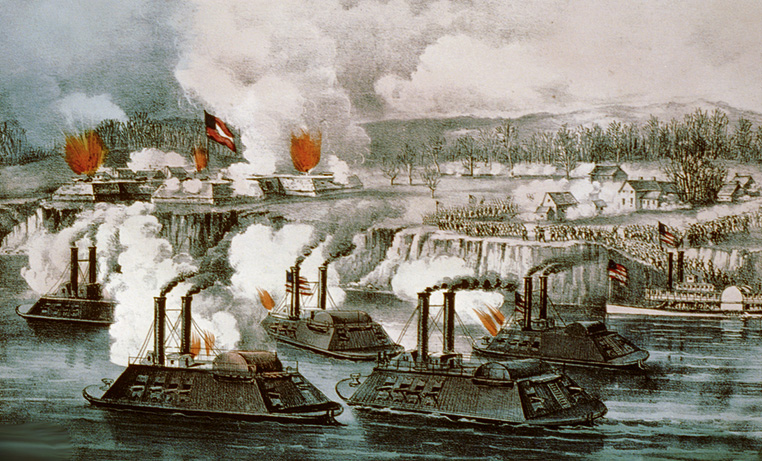
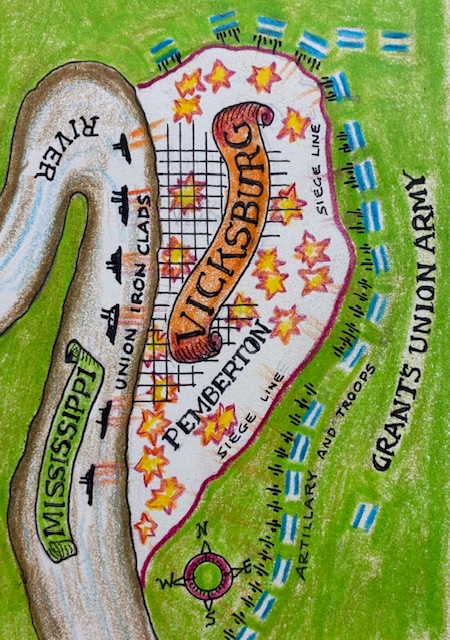
The siege of Vicksburg was a long one, dating from December 29, 1862, to July 4, 1863. Admiral Farragut had tried to take it in the early part of the maneuver by using his larger navy ships, but they were not built for the shallow, swift river, so he backed off. Grant knew he would have to take Vicksburg by land with his army and by the river using squadrons of smaller, heavily armed river craft with crews that understood the river currents. Many of these men he culled from experienced soldiers and navy crewmen who understood the river’s complexities. He also culled out artillerymen who could be accurate on smaller moving riverboats. His crews were mocked as “Brown River Sailors” due to the muddy brown color of the Mississippi River.
His fleet became a fleet of iron-plated river boats built to order by Grant’s naval coordinator, Admiral David Porter, in shipyards in St. Louis, Cincinnati, and Illinois, along tributaries of the Mississippi, to avoid being jeopardized by the South. These ironclads had thick, flat oak hulls with the superstructures made of the same strong wood frames, which were then clad in thick iron plates with openings for naval cannons. They were propelled by steam engines and were just about fast enough to stay out of trouble. In addition, “found” commercial riverboats retrofitted to become troop carriers to be used for troops and ammo. The most threatening of the attack ships was the ironclad USS Cairo, which was one of the larger gunboats and bristled with cannons. The Cairo is the only one that ever sank. It was recovered and survives as a monument and museum in the present city of Vicksburg. Other ironclads were the USS Louisville, Mound City, Carondelet, and Pittsburgh. This fleet’s first encounter against rebel positions on the river was at Grand Gulf, Mississippi, when these gunboats engaged Confederate artillery as Grant tried to move troops across the river. He was repulsed and had to move downstream out of range to get his troops across. Next was Snyder’s Bluff, Missouri, when Grant moved troops across to impair the Confederate forces North of Vicksburg. Grant’s ironclads then moved on to escort a major army movement landing near Vicksburg and moving inland towards New Carthage, LA, to facilitate a large rear action maneuver against his major target, Vicksburg
By May 19th, many of Grant’s troops had been moved across by the river boats and had almost surrounded Vicksburg by land and river. However, the ring was never completely closed, and a small number of supplies could still reach Vicksburg through a gap in the encirclement. The commanding Confederate general was Lt. Gen. John Pemberton, leading the army of the Mississippi with four divisions. With limited access to supplies, Pemberton went into siege mode. On March 21, Union land artillery and coordinated firepower from the ironclads opened up with an earsplitting barrage. It lasted all night. The battle lasted all day and ended up being a carnage that still had little effect on the Confederates’ fighting spirit. Grant then decided he would lie back to starve and siege the city into submission. The Union ironclads fired over 22,000 rounds into the city from the river while artillery pounded the city into a scrap heap from their land positions. The battle raged all through June, with the Union holding the upper hand while Grant fought off several relief attempts by the Confederate army.
Pemberton finally realized his situation and began negotiations with Grant to surrender. He had no way out. The Mississippi River, which would normally have offered an escape route, was controlled and patrolled by the lethal Union gunboats. The final surrender took place on July 4th, 1863. It was a double whammy day for the Confederates, for on the same day, General Lee retreated from Gettysburg, having acknowledged the defeat to himself. Sadly, the war went on for another two years, but the writing was on the wall. Few people realize how important the control of the entire Mississippi was to the winning of the Civil War. President Lincoln did. He picked the right general for the job, who would realize the importance of the navy and work with its officers to build and utilize new, flat-bottomed, iron-clad river boats to defeat the Confederates in the west.
Copyright 2026 by Mark C.(Sea) Nuccio
All rights reserved
For all accolades, comments, and complaints, please reach me at marksea46@gmail.com