
Overview
In March, we start to feel that desperate pull for spring to begin. It’s a transitional month, and one that goes out of a cold month and into a warmer one, which for me can be a frustrating time. For some reason, despite it having similar sun exposures to the fall months, March just feels like winter digging its claws in and refusing to let go, despite many of us anglers especially wishing it would just take a hike. In fact, my rule for winter is that I love snow until March 1st, and then it can respectfully kick rocks.
That same sort of itch for warmth also makes its way around fishing circles in March. Lakes that got iced over, which this winter was basically all of them, are going to open up in March and allow for some open water fishing. I usually switch from targeting cold winter trout and salmon with my centerpin setup to targeting open water bass, pickerel, pike, trout, and salmon. On the right day, March can feel kind of like October if the weather cooperates. On the wrong day, it feels like January! A true transitional time of year. So, let’s talk a bit about what you can do locally to scratch that late winter itch and put a bend in your rod. For some of us, it might be the first time out since Thanksgiving!
Freshwater
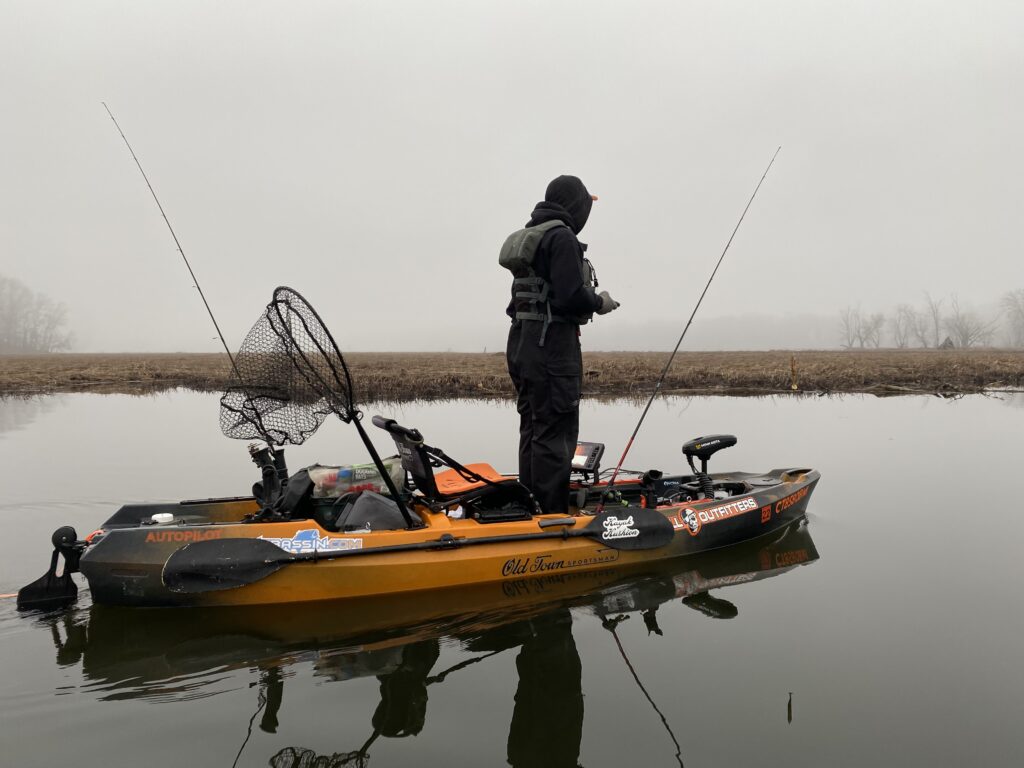
My number one tactic to straight-up catch fish in March is to troll small diving plugs. Rapala jointed minnows, Rapala X-Raps, any inline spinner, and really any shallow-running bait that can be trolled along slowly without sinking too far and snagging the bottom or the weeds. I use a 7-foot medium light rod and a 2500-size spinning reel with 10lb braid and a long leader of 6lb mono, which is my primary fighting line for this time of year.
Your best bet in terms of finding the fish is to go to places that serve you well in the fall. I usually try to focus on early growth veggies, points, or shallow coves and their entrances. My target depth is typically 6-12’, which often puts me near the shoreline. Since I’m in a kayak, one rod goes in a rod holder and one gets held onto. I’ll go slowly, around 1.3-1.7mph and trace the shoreline, sticking to my desired depth.
A great tool for finding fish this time of year is your fishfinder, particularly if you have it tuned into reading shallow water returns. In March, when vegetation is at a minimum, there’s not much to trick you into thinking you’re seeing fish marks. So generally, once you start to see some scratches of life on your sonar, you can be sure you’re in the right spot. This will be particularly true if you’re around white perch, crappie, or yellow perch schools, as they tend to school up tightly. Trout, bass, and pickerel will generally hold in a few key areas of a standard lake, so typically the hardest part is trolling around until you find them. Often, I find it can be one section of shoreline or one point that holds all of the fish I’ll catch in a given day. So, stay on the hunt, and when you begin to get bites, try to zero in on the hot spot and keep running back and forth over it.
Another fun tactic in March is to scout some deeper water for the aforementioned tightly packed schools of crappie, white perch, or yellow perch. The marks are usually unmistakable and will look like a cloud of bait that you might see out in the saltwater. Once you’re settled into a promising area, drop a small spoon straight down and slowly hop it up and down near the bottom or near the depth you’re marking fish at. The bite is usually kind of smushy and less of a “hit” than just some tension on your line, but it’s still fun on an ultralight rod.
Saltwater
In March, anglers coming into the shop will begin trying to focus on holdover stripers with a bit more vigor than they did in the cold months. This is especially true this year, when pretty much everything froze over and made casting impossible in general. Your best bet for some holdover stripers is to target tidal creeks and their holes. In general, I find that 90% of the holdover stripers will congregate in 5% of the area that you’re fishing in. So, the hunt could be tiresome, but once you find a pocket of fish, if they’re chewing, it’s worth it. Sometimes they just don’t want to bite, and that’s the risk you take any time you’re fishing, but especially when you’re targeting holdovers.
My go-to baits for holdover stripers are Lunker City Fin-S Fish and Yo-Zuri Mag Darters. I like the slow fall of the Fin-S Fish more and tend to use those weightless before anything else. If you do get it in front of some willing stripers, the bite is certainly more exciting than a sluggish freshwater trout. They won’t fight as they do in the warmer months, but hey, it’s something!
Similar to freshwater in March, I find I rely heavily on my electronics, and even more so, I find that true for targeting holdover stripers. Side imaging in particular is really helpful for cruising along and searching for splotches of stripers belly-down in the tidal creeks. Starting to look in the deeper holes is a good idea, but don’t be afraid to branch out to shorelines, almost like you might be looking for largemouth bass. I have caught many more holdover stripers in January, February, and March that were along shallow shorelines than I have stripers that were hunkered down in deeper holes.
Overall, March can be frustrating, but if you put in the time and hammer down some reliable patterns and spots, it can definitely be the month when you have your first solid fishing trip of the year.