One Sunday morning in the middle of January 1984, Bo Curtis left Rockland, Maine, in his 15-foot outboard and headed for Kent Cove to dig clams. En route, a sudden snow squall packing 35-knot winds roared across Penobscot Bay and overtook Curtis’s small skiff. The craft began taking on water and, while Curtis bailed furiously, the boat was blown miles off course.
Hours later Curtic spotted a buoy and decided to try and tie up to it. The wind was still howling and the temperature had dropped into the single digits. But when he came close and reached for the buoy, his boat lurched out from under him. Soaked and weary from bailing, he managed to scramble onto the see-sawing, ice frocked can.
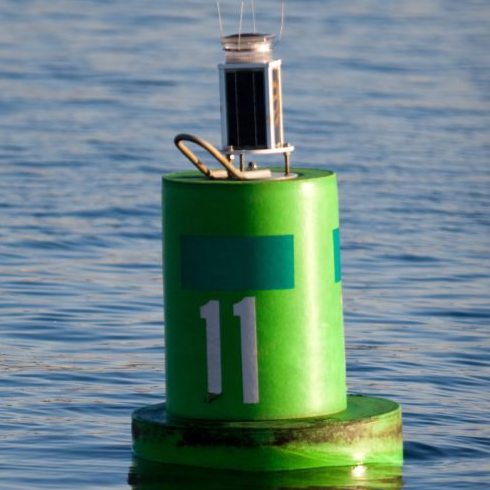
Curtis was reported overdue and missing that evening, and the Coast Guard commenced a search by boat and helicopter. Meanwhile, Curtiss huddled on the frozen buoy fighting the cold and nearing exhaustion. He had tethered himself to the buoy with his belt and sat on his down vest to keep from freezing to the hard metal surface. Every so often he burned a piece of his rubber boots with a cigarette lighter to keep his hands and face from freezing.
Almost 24 hours after the ordeal began, Curtis was rescued by the USCG cutter POINT HANNON and taken to the hospital. Except for mild frostbite on his hands, he was in good condition and recovered quickly. Youth was on his side as well as health and a strong spirit, but it was the buoy that saved him. Its constant song and dance kept him awake as it held him anchored in the same spot until he was found.
Not every buoy can claim such a glorious lifesaving deed but, in one way or another, all buoys save lives. Whether marking a treacherous channel, calling a warning through the fog or collecting weather data, all buoys perform a critical service at sea. Dauntless, durable and dependable, they’ve been bobbing about for centuries.
Buoys were first used in this country before the Revolution, but their origin goes back to the earliest navigators who moored buoyant objects – logs, gourds and clay pots – along well- traveled routes. As early as 1767, colonists marked portions of Delaware Bay with wooden spars held in place by iron sinkers and hemp line. These simple sign posts were carved from the most buoyant woods and, though unattractive, were regarded as objects of great value. The Virginia Colony made tampering with or removing them a crime “punishable by death without benefit of clergy.”
By 1808, island strewn Boston Bay had a small number of buoys to mark the danger spots. Some were spars similar to those in Delaware Bay, but a new type with barrel-like stave construction had come into use. These wooden buoys varied in length from 12 to 60 feet and were crafted from spruce, pine or cedar. Some were sheathed in iron for added protection, but all had to be returned to shore periodically to dry out and regain their buoyancy. Many had to be replaced altogether after being accidentally run over by a passing ship.
About 1850, all-iron buoys appeared. Compartmented for flotation, they proved more durable than wood, but ships grew concerned about hitting them. One sunken buoy raised from the deep after The War Between the States has pieces of a ship’s screw inside it – proof that it died fighting and sent its adversary back to port with a limp. Buoys in areas where collisions were more commonplace were equipped with jagged rings of saw teeth capable of severing towlines if the buoys became hung up on a skipper’s misjudgement.
When a buoy was separated from its mooring in a collision or storm, it often became a nomad, roaming the seas for weeks or even months before being recovered. The dangers of such an object are obvious: vessels might have mistaken it for a properly positioned marker or unknowingly smash into it. “Such an animal at large is a killer,” wrote maritime historian H.C. Adamson.
Incredible journeys were sometimes made by those vagabond buoys. In 1911, a San Francisco buoy disappeared from its station and turned up 17 months later off Maui, Hawaii. Still another broke away from its anchor off Cape Hatteras in a 1912 storm and rode the Gulf Stream clear to Ireland, where it washed up on the beach near Fastnet. Local villagers mistook its shrill whistle for the laugh of an evil banshee.
Today’s familiar “can and nun” buoys, named for their obvious shapes, were introduced in the late 1800s, as was the first lighted buoy – an oil fixture placed in New York Harbor in 1881. A decade later, electric lighting was attempted with cables laid from a mainland power station to the buoy. The cables frequently parted, however, so the fickle system was abandoned and experiments were begun utilizing gas illumination.
A short time later acetylene gas was used to light the buoys – through the action of sea water on calcium carbide. Scientists found a way to compress the gas in tanks which were placed inside the buoys lighting mechanism. The system worked like a kitchen range, with a valve controlling the gas flow to the pilot flame. It allowed buoys to burn unattended for about a year. A few or these are still in use, but electric buoys powered by watertight batteries or solar collectors (or a combination of the two) are today’s norm.
The first audible buoys, fitted with bells, appeared in seaways around 1850. The distinctive, monotone “bongs” of the bell buoy were produced by motion-sensitive clappers that swung with the slightest motion of the sea and differentiated themselves with a melodious series of random tones. The U.S. Lighthouse Service, which tended buoys prior to the Coast Guard, estimated that the wear on the clapper of a bell buoy in a single week equaled 150 years of wear on a typical church bell.
Whistling buoys, invented by J.M. Courtney in 1871, used the sea’s up-and-down motion to compress air and force it through their whistle heads. Like foghorns, these buoys were often unpopular and maligned by the landlubbing public because of their unending cacophony. Residents of Atlantic City, N.J., demanded the removal of the whistling buoy in the 1890’s because it sounded like a woman crying and disturbed the resort vacationers who were unfamiliar with this coastal sound.
Modern buoy signals are produced by timing mechanisms that insure constant characteristics. In addition to audible signals, many also offer beacons and radio signals. High tech weather buoys, moored or adrift, relay marine meteorological data via satellite link to NOAA’s National Data Buoy Center in Mississippi. The Navy’s valuable rescue buoy, equipped with distress radio transmitters, are used to locate and mark-stricken ships – particularly submarines – and downed aircraft. NASA used them to help locate splashdown capsules in its earlier space missions.
The most impressive buoys are the LNB’s (large navigational buoy) developed by the Coast Guard in the 1960’s to replace the flotilla of aging light ships which marked remote spots. These 10-ton oceanic behemoths look like bobbing tops from the air, but are 40 feet in diameter and dangle on a massive 12,750-pound anchor. Complete with lights, fog signals, radio beacons and radar reflectors to intensify their “blips”, LNB’s require maintenance only once every six years.
Maintaining buoys is one of the Coast Guards most rigorous tasks and their fleet of buoy tenders are the workhorses of the sea. A tender spends almost half the year out of port hauling buoys for scraping, painting, refitting, refueling and repairing. The work is hard and dirty and sometimes full of surprises. In 1920, a tender working off Delaware spotted what was thought to be a buoy gone adrift. To the astonishment of the crew, the buoy turned out to be an American submarine that had sunk in the vertical position, leaving its stern projecting out of the water. The subs 38 crewmen were safely rescued and a warning buoy was placed on the wreck to keep other vessels from hitting it.
The USCG cutter HAWTHORNE was sent to repair a buoy off Montauk in 1925 after boaters reported its light extinguished. A gas buoy, it was a very crucial landfall aid at the tip of Long Island. When the crew opened the buoys lantern, out came the cause of the problem.
“Four or five hundred horseflies – not ponies either, but the largest kind – came swarming out”, the captain noted in his log. Apparently, the flies had been drawn to the beacon and gathered so thickly around the flame they snuffed it out.
Birds can also create problems. Buoys make great roosts, and though a handsome seabird perched atop a buoy is a delight to the mariner’s eye, corrosive bird droppings obscure a buoy’s markings and light signal, and cause a general destructive mess. And a nest can muffle the sound signal as well and endanger maintenance efforts. More than one tender crewman has been attacked by an angry avian while attempting to remove its nest from a buoy. To discourage birds from roosting on buoys, a sharp-toothed metal ring is installed to thwart their footholds.
Though not the prettiest denizens of the sea, and often taken for granted by those who need them most, buoys have garnered some poetic affection from time to time. Rudyard Kipling’s “The Bell Buoy” immortalized the go-nowhere mission of these underrated navigational aids, while Robert Southey accurately captured the terror of the Bello Rock near Scotland’s Firth of Tay, where a monk supposedly anchored a warning bell in the 14th century.
But the prize for “buoy bathos” undoubtedly goes to the crew of the Nantucket South Shoals Lightship. The men ardently declared their affection for the red buoy visible a mile west of the lightship’s hazardous anchorage. The skipper often waxed poetic about the buoy in his log entries, noting that it had taken on an almost human personality with its rotund shape and incessant dipping and reeling.
“A man rarely comes up from below,” he wrote, “without casting a look over the bulkwarks to see if the buoy is still there.”
To the lightship’s crew – sequestered at sea for months on end without land in sight – the Nantucket Southwest Shoal bell buoy seemed as a plump, happy girl in a red party dress, dancing on the sea.
In the end though, buoys can only help a person in distress so much. Just ask Krissy Watkins, of Amity Island, when she went for a late-night swim back in 1975. Dah-dum, Dah-dum, Dah-DUM!…