The very mention of City Island evokes for many boaters a maritime history unique in New York, specifically in Long Island Sound. Of course, sailors think of beautiful yachts like Brilliant, built on City Island in 1932 but still active at Mystic Seaport, or Dorade, launched in 1930 but finishing first in the Transpacific Yacht in 1936 and again 77 years later in 2013. Both boats, along with many other famous sailboats, including the 12-meter sloops that successfully defended the America’s Cup for nearly 30 years, were built on City Island during the 20th century. However, City Island was also well known for its motor-driven boats, some of which played important roles in American history and were just as impressive as their wind-powered counterparts.
The oldest shipyard on City Island was established in the 1850s by David Carll from Northport, Long Island, after he had worked with Samuel Prior Hart on a marine railway on the east side of the Island. Carll specialized in schooners (including a rehaul of Magic, the first defender of the America’s Cup, in 1870) and oyster sloops and schooners, but as early as 1875 he built for the U.S. Coast Guard a light vessel, or light ship, called Vineyard Sound, which eventually sank while being towed but not for another 100 years, in 1975. Carll’s last boat before his yard was sold to Henry Piepgras in 1886 was a pilot boat for the Sandy Hook Pilots, which sank in a collision (with what we don’t know) in 1893.
Another early Island shipbuilder was A.B. Wood, who established a shipyard on City Island in 1860. His son, B.F. Wood, carried on the business until it closed in 1930 and eventually ended up as part of the Robert Jacob Shipyard. B.F. Wood must have enjoyed breaking records, because as early as 1893 he built Feiseen, which set a speed record of 31.6 miles per hour, and in 1908 he built Asor II, the largest gas-powered boat at the time.
Archibald Robertson, who built boats on City Island beginning in the 1880s, designed and produced several oyster sloops, as did many local boatyards at that time, when the oyster business on City Island was at its peak. According to Ernest Ingersoll of the U.S. Bureau of Fisheries, City Island owned one fourth of the 100 boats engaged in taking oysters to the city, and that “100 men and families on the island obtained a living by oystering.” In 1907, Robertson was commissioned by the NYC Charities Department to build two boats, a 77-foot-long steel passenger steamboat and a 169-foot-long twin screw passenger and freight steamer. Because of bureaucratic complications, however, they could not be completed, and Robertson was not paid; he filed for bankruptcy in 1909, the year he built one of his last boats, Atlantic City.
George W. Byles was the son of a British-born boatbuilder who worked in Brooklyn for George Steers, who had designed and built the yacht America for which the America’s Cup is named. George moved to City Island in 1869 and established a boatyard on the east side of City Island, where he produced and rebuilt many relatively small sailboats and other craft. In 1885 he was commissioned to construct a steam launch named Frolic for a company formed by some New Rochelle residents. The boat was 50 feet in length and weighed 20 tons. According to a report, “The cabin and berths will be elaborately fitted up, and she will be supplied with a 20 horse compound engine, and a 36 inch screw. When finished she will be capable of accommodating about 60 persons.” Byles remained in business until 1908, when he sold his yard to boatbuilder Henry Nevins.
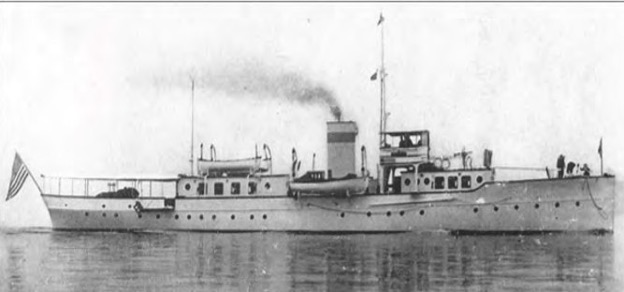
Henry Piepgras, who bought David Carll’s yard in 1886, specialized in schooners and sloops, and his successor, Robert Jacob, who purchased the yard in 1900, did the same for the most part until World War I. In 1914, however, before the United States entered the war, Jacob built Caroline, at 187’ 8” the longest yacht ever built on City Island. She was designed by William Gardner as an excursion yacht for Edward Ford of Toledo, Ohio, who sold her in 1917 to the estate of Horace Dodge of Michigan, an automobile manufacturing pioneer. In 1919 she was renamed Delphine in honor of Dodge’s daughter and in 1922 was bought by Stella Ford Schlotman (one of the founders of Planned Parenthood), who renamed her Stellaris. In 1940, Stellaris became Sylph II when she was sold to but never used by New York Waterway Yacht Cruises of Brooklyn, and two years later she was purchased by the U.S. Navy, which classified her as a patrol vessel and renamed her USS Lash. She patrolled the coast off New York until October 1942, when she sailed south and served as a patrol vessel out of New Orleans; she then left the United States and worked as a ferry named Nisyros
In August 1918, Motor Boating magazine published an article entitled “America’s Largest Motor Boat” about a 157-foot diesel yacht named Aramis, which had been built at the Robert Jacob yard in 1916. “An unusual feature for a yacht was the large organ that has been built into the deck house in such a way as to carry out the general decorative scheme.” Nevertheless, the author of the article was most impressed by the size of the boat’s six Craig Diesel motors, which he praised for their economy in consuming only 40 gallons an hour at the cost of 3.5 cents a gallon. During World War I USS Aramis worked for the Navy and remained Navy property until 1933.
The beautiful yacht Nourmahal was the first of three yachts built for Vincent Astor to carry that name. Designed by Cox & Stephens and built at the Robert Jacob yard in 1921 for $375,000, Nourmahal, at 160-feet was the largest diesel-powered yacht at that time. Astor sold the boat in the late 1920s, and she was renamed Conseco. The Royal Canadian Navy lacked Canadian-owned boats suitable for naval service, so shortly before World War II, yacht owners went south to the United States to find some. Conseco was acquired and brought north to Halifax, Nova Scotia, where the vessel was converted to an armed yacht in 1940. Renamed Otter, the ship participated in the Battle of the Atlantic, escorting convoys and patrolling the Canadian coast. On 26 March 1941, Otter suffered a catastrophic fire aboard that sank the yacht, taking two officers and 17 sailors with her.
It should not be surprising that City Island became well known during Prohibition for its rum runners, including Sea Hornet, built by Kyle and Purdy (which had produced many military vessels during World War I) as an experimental torpedo boat. The launching of Sea Hornet, on December 12, 1920, was a major event attended by many high-ranking military officers, but within three years, the bulletproof boat, renamed Com-an-Go, was a busy bootlegger runner until captured in 1924 in Mystic, Connecticut. Another well-known boat, Baby Bootlegger, was designed by George Crouch and built at the Nevins yacht yard in 1924 but was actually designed for racing rather than running rum. The boat still survives, thanks to Mark Mason, who found the boat in a Miami junkyard in the 1980s and restored it to its original beauty. His New England Boat & Motor Company not only restores original boats but also reproduces new ones according
One of the most prominent boat builders on City Island was Henry B. Nevins, who opened his yard in 1907 alongside the property owned by George Byles, who sold it to Nevins the following year. Nevins built sail and motor yachts and racing boats for private individuals, but he also constructed small barges and tugboats, and in 1939 was awarded $15,000 by the U.S. Navy for the design of a torpedo boat. During World War II and the Korean War, Nevins designed and built YMS-1 class minesweepers for the Navy, often turning them out in less than four months. The Robert Jacobs yard also built minesweepers, one of the 35 American boatyards that built a total of 561 minesweepers. Many other types of military craft were built on the island by Nevins, Jacobs, Kretzer’s Boat Works, and the United Boat Yard, including PT boats, tugs, landing craft and submarine chasers.
Many people try to avoid heavy traffic on City Island as visitors flock to the seafood restaurants, but nothing could compare with the traffic that boat building caused during World War II. According to islander Leo Keans: “at 4:30 in the afternoon, if you stood on the corner of Ditmars Street and City Island Avenue and looked south, whether it be summer or winter, cars would come up City Island Avenue three abreast. And they wouldn’t stop passing for half an hour. Flying to get off the Island, to get home. There must have been, I don’t know how many, thousands upon thousands of people working up here during the war, building minesweepers.”
In 1923 Henry Nevins, who had built many commuter yachts, was asked to complete one named Corisande at the request of Marshall Field III, who lived on a grand estate on Long Island’s north shore and used her to travel to his office in Manhattan. Corisande’s skipper, Captain Jack Stafford, lived on Pell Place in City Island, and legend has it that, when he was near Hart Island on his way home, he would wave a pillowcase to signal his wife so that she would know when to have his dinner ready.
One of Nevins’s most famous boats was Analgra, which was designed by Charles D. Mower for Lewis E. Pierson, president of Irving Trust and the United States Chamber of Commerce. Nevins built Analgra in 1930 for $250,000, at 120 feet the largest yacht so far built at the yard. A few years later another Nevins customer, E. Townsend Irvin, commodore of the New York Yacht Club, purchased the boat and renamed her Tara. During the early 1950s Gen. Douglas McArthur, then CEO at Remington Rand, used the boat, but she later became more famous as Lovely Lady on the West Coast, where she appeared in several films, including “Some like it Hot” (in fact, Marilyn Monroe used the yacht as quarters during filming and many renamed her Norma Jeane, Marilyn’s real name), “Tequila Sunrise” with Mel Gibson, and later the Batman movie and television show. Sadly, in April 2009, she sank while being restored at a marina in Miami.