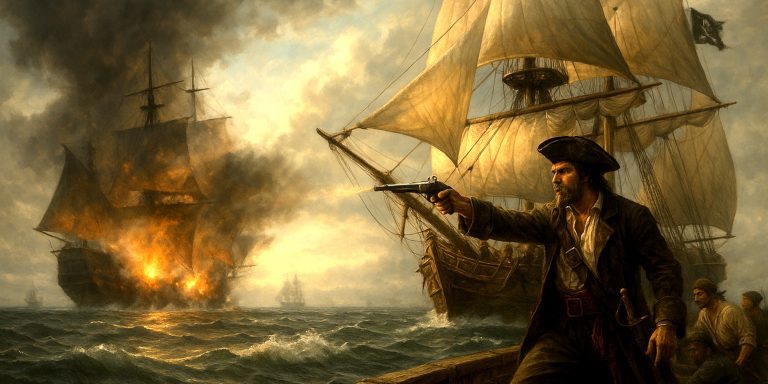
Despite the sailing ship’s constant forward and aft pitch and sway from side to side, the pirate lookout stood high up in the crow’s nest, as he searched for any approaching vessel in nearby waters. Using a spyglass, he would determine its nationality by its flag, the type of ship, its probable cargo and its possible armament. The pirate ship then might follow their possible prize for several hours or even days before a decision was made to attack.
As the pirates approached the target ship, they hoisted their Jolly Roger and demanded that the vessel come to a halt. If it tried to sail away, a canon shot was sometimes fired across its bow. As the pirates approached even closer, its crew members tossed grenades, glass bottles filled with metal fragments and gunpowder. Slow-burning material inside the bottle’s neck ignited the grenade. Using lines attached to grappling irons, the pirates then hurled them onto the prize vessel’s deck allowing the pirates to pull the two vessels closer together. Armed with flintlock pistols and a cutlass, they boarded the ship and quickly overcame the ill-prepared crewmen.
Treasure gained from a captured ship was divided with multiple shares going to the captain and officers, while the crewmen received one basic share. However, what they received was enormous compared to what they would have earned as crewmen aboard a merchant ship or when working ashore
The Golden Age of Piracy ran from about 1650 to 1726. Pirates operated in the Caribbean, Atlantic coast, West Africa and the Indian Ocean. Boston Harbor during that period was a center of colonial shipping, shipbuilding and outfitting. Pirate vessels, frequently loaded with their hoard of Spanish and Portuguese gold, silver and other stolen goods were more than welcomed in Boston as they were at other North American and West Indies ports. The illicit treasures helped local economies. The ports also provided ample supplies for the pirates’ further forays in the world’s oceans.
In 1692, Captain Thomas Tew, originally from Rhode Island, began his maritime career as a privateer, appointed by the Governor of Bermuda. As a privateer, he was allowed to attack and capture French ships, enemy of the British. The captured prizes were then shared with the ship’s company and privateer’s sponsor. Though privateer Tew was successful, he and his crew soon decided to switch to piracy, allowing them to keep all the proceeds of their ventures.
In 1693, Tew and his pirate crew reached the Red Sea where they sighted a large ship in-route from India to the Ottoman Empire. Captured without much of a fight, the ship was a treasure of gold, silver, ivory, gemstones, silk and spices. The share for each of the crewmen amounted to $4,000 each in today’s dollars. Tew’s share was said to have been about one million! He was soon called “Rhode Island’ Pirate” and was regarded as one of the richest pirates in history. However, his adventures were short lived.
After returning to Newport, Colonial Governor of New York Benjamin Fletcher contacted Tew. They soon became close friends and business partners. The captain received a letter of marque from Fletcher and set out for a second cruise. After a stopover in Boston, they sailed again to the Red Sea, arriving there in 1695. As they attacked a well-armed Mughal vessel (today’s Uzbekistan), Tew was killed by canon fire. Though his entire crew surrendered, they were later freed when another colonial pirate ship overcame the same Mughal vessel.
On October 15, 1673, Massachusetts Bay Colony declared piracy as a capital offense. When captured, pirates were executed by hanging. But the practice of robbing ships at sea carried on. Like Tew, Captain Samuel Bellamy also became a very wealthy pirate. While navigating between Cuba and Hispaniola, the three-masted, 110 feet long galley ship Whydah was spotted by Bellamy’s lookout. Transporting some 500 slaves from Africa, the ship was also carrying a load of gold, Akan jewelry and ivory. The pirates easily took possession of the Whydah while the slaves were transferred to Bellamy’s former ship and sent on its way.
The Whydah was capable of speeds up to 24 km (15 mph)! Armed with about 20 cannons and 150 crewmen, the pirates became formidable robbers at sea. Over a very short time, they captured 53 ships. As they made their way up the coast from the Carolinas, the Whydah crew captured the Mary Anne. It was carrying some gold and silver. However, the vessel also had a cargo of more than seven thousand gallons of Madeira wine. The crewmen were ecstatic; what a haul! Something that they could drink.
On April 26, 1717, as they headed further up the Atlantic coast toward Maine, it all came to an end. Sailing off Cape Cod in the dark of night, the Whydah and its two companion pirate ships were struck by a fierce storm. Bolts of lightning lit the sky as heavy rain squalls battered the fleet. The winds gusted up to 80 miles per-hour, and 50-feet waves unmercifully tossed the ships from side to side. As the Whydah was driven closer to the shore, it grounded on a sand bar. Waves continued to batter the ship tearing away its cannons. Shortly after, its main mast broke and the vessel overturned. Bellamy was lost along with most of the galley’s crew; at least 102 bodies were washed ashore. Only seven crewmen had survived. Of that number, one was found innocent of piracy but following their trial, the remaining members were executed by hanging.
After more than 265 years, the Whydah wreck was located by underwater archaeological explorer Barry Clifford. Discovered off Cape Cod’s seaside town Wellfleet, it was located some 2,000-feet offshore, buried in 15 feet of sand at a depth of 14 feet. water. Divers recovered over 200,000 artifacts along with six skeletons of the crewmen. Most importantly, they recovered the ship’s bell inscribed with “THE WHYDAH GALLY 1716,” assuring everyone that the wreck was truly the Whydah. The Whydah Pirate Museum, in West Yarmouth, has many of its artifacts on display.
Boston’s last engagement with pirates occurred in 1832. Spanish Captain Pedro Gilbert and his pirate crew, aboard their schooner Panda, invaded the brig Mexican, bound from Salem, Massachusetts to Rio de Janeiro. It was loaded with $20,000 in silver. After looting the treasure, the pirates locked the Mexican’s crew below deck and set fire to the brig. Luckily, the crewmen were able to escape and put out the fire. About two years later, the pirates and captain were captured by the British aboard the brig HMS Curlew. The pirates were then taken to Boston where they underwent a trial. Found guilty, Boston’s last pirates were executed on June 11, 1835.