
Broken and broken
again on the sea,
the moon so easily mends.
-Chosu
On the open ocean, with only sea and sky in view, the moon becomes an object of intense fascination. At sea, there is nothing to distract from its capricious celestial show, no place to hide its fickle face. Sailors say it’s as predictable as a fine timepiece, waxing and waning to the tick of some immense cosmic clock.
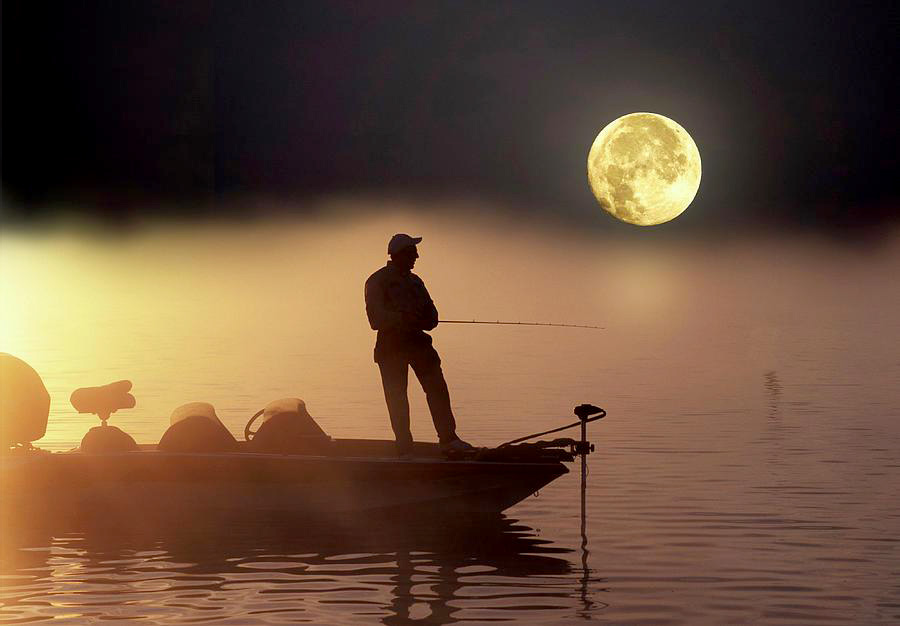
But within the moon’s monthly cycle, sailors of old saw harbingers of earthy importance – omens for the future that required careful interpretation. Some of these signs foretold the weather while others gauge a ships fate and a sailor’s luck. Whatever secrets the moon held, the seaman was determined to uncover and use them to his advantage.
Hundreds of marine weather superstitions and proverbs pertain to the moon, some surprisingly accurate, others as fanciful as green cheese. Many have ancient origins, surviving from an age when lunar deities were thought to control the seas and to determine the fortunes of those who ventured out upon it.
Sailors put great stock in reading the sky before going to sea. In their minds, the sea and sky were joined, with one able to foresee and reflect the behavior of the other, as well as influence or even to govern it. The moon could bring luck at the launching of a ship or at the beginning of a voyage, and at sea it became a trusted weather prophet.
Old English beliefs about the moon and its authority over certain days of the week dictated the activities of shipbuilders. The keel was always laid on a Wednesday when the moon was full. Wednesday belonged to Wodin, the supreme god of the Vikings and the special protector of mariners. The full moon’s power over the tides was thought to bestow strength on a ship’s keel.
When it was time to launch the new ship, a full moon, especially at perigee, added its gentle tidal tug to a vessel rolling off the ways. A launching at full moon on a Monday – Moon-Day – was even better. It imparted the moon’s blessings and insured the ship’s seaworthiness. Once at sea, a ship’s crew relied on the moon for important information, mostly of a short-term nature. The moon’s appearance augured the weather for the following day or two, but was occasionally used at the beginning of its cycle to determine the amount of rain for the coming month.
Much of the folklore surrounding the mariner’s moon relates to storms. The old ballad of Sir Patrick Spens contains a typical warning:
I saw the new moon with the auld moon in her arm,
And if you’re going to sea, Captain, I fear we’ll come to harm!
The balladeer was, of course, referring to that period when the waxing crescent moon emerges in the early evening sky with the faint outline of the moon’s unlit portion also visible. Today we know that earthshine – light reflected from our planet onto the moon – is responsible for this eerie phenomenon, and that it happens when the air is exceptionally clear and stable. But for the sailor it was a sign of an approaching blow, perhaps the cynical old idea of the “calm before the storm” that was meant to lure a ship into the clutches of an unforgiving sea.
Longfellow’s well-known Wreck of the Hesperus contains another lunar curiosity that provided important weather information to the mariner. A superstitious old salt aboard the Hesperus cautioned the captain about the portent of a hurricane:
Last night, the moon had a golden ring,
And tonight, no moon we see!
French seamen believed a circle around the moon meant sailors go aloft soon. Of course, if a storm was thought to be on its way, sailors would furl the topsails to make the ship ride more stable in the wind. Adding charm to this lore of moon rings was the mariner’s certainty that the thickness of the ring indicated the intensity of the storm, and the number of stars seen inside the ring determined how many days the storm would last.
Fishermen of the Shetland Islands called a lunar halo ‘Van-gar-for’, meaning “rain goes before.”
In this case, it foretold rain before the next day, lasting two days.
Such exquisite lunar rings are actually caused by the moonlight passing through atmospheric moisture, usually in the form of ice crystals high up in the atmosphere. But they might presage a storm if they have blown off the cloud tops of thunderheads or formed from warmer, moist air preceding a storm front.
Moon brightness and color were of great importance to the weather-watcher at sea. A large, bright moon meant clear cool weather; a dull and hazy moon meant a change to rain and possibly hot, balmy days and nights.
Pale moon rains;
Red moon blows;
White moon neither
Rain nor blows.
This little sailor’s ditty holds some truth, since the color changes in the moon result from air quality. When the particles in the air are denser, water droplets can form easier and the blue parts of the color spectrum are scattered, leaving a copper cast to the moon. Clean air, on the other hand, lets through all the colors of the spectrum, resulting in a white moon. The pale moon may appear slightly blueish because humid air contains numerous miniscule water droplets that scatter red light.
It’s already been said that stars twinkling inside a moon ring were indicators of a storm’s duration, but other information could be divined from the moon’s position in relation to the stars around it. A variety of old adages regarding this were repeated by the sailor:
One star ahead of the moon, towing her, and another astern, chasing her, is a sure sign of a storm. If a big star is dogging the moon, wild weather may be expected soon.
Even Samuel Taylor Coleridge’s Rime of the Ancient Mariner had a word or two to say on this subject:
The stars were dim, and thick the night,
The steersman’s face by his
white;
From the sails the dew did a
Till clomb above the eastern
The horned moon, with a bright star
Within the nether tip.
Stars leading or chasing the motion have no meteorological importance, of course, but their excessive twinkling of their dimness might have caught a mariner’s attention. These conditions could indicate unstable air or a storm front moving in.
The same holds true for the pointed horns of the crescent moon. Seamen were meticulous about analyzing these and also cautiously observed how the moon rose and set. A crescent moon with horns pointing up was called a “dry moon” and was thought to hold no water. A “wet moon’s” horns pointed down and were a sign of rain.
Some of the maxims associated with these appearances include:
If the moon lies on her back
She suck the sea into her lap.
When the moon lies on her back,
Then the sou’west wind will crack.
When she rises up and nods,
Chill nor’easters dry the sod.
Anyone who has patiently observed the night moon knows the horns normally point up on a waxing crescent moon and down on a waning crescent moon. However, the early daytime moon appears just opposite – horns pointed down as the moon waxes and up as it wanes. The season of the year and the moon’s Metonic cycle (a 19-year period in which the phases of the moon repeat on the same days of the solar year) will also have some influence over the direction the horns point. Their tilt is more pronounced in summer than in winter and also at the height of the 19 year cycle when the moon attains its greatest altitude above the horizon. It would seem that deciding whether the horns are wet or dry is a matter of careful judgment, coupled with the time and date.
While the posture of the horns may be steeped in superstition, their clarity offers some indication of weather. Sailors of old claimed sharp and pointy horns on a crescent moon were a sign of fair weather and, indeed, calm and stable air would produce such acuity and indicate at least a brief period of smooth sailing. On the other hand, if the horns were dull and difficult to discern, bad weather might be on the way, evidenced by turbulent air.
The moon’s appearance in or near the clouds carried important messages about the weather at sea. If moon beams pierced the clouds and were cast down upon the water, sailors thought the moon was drawing the sea up and rain would soon arrive. The ring on the back of a cloud brings tempest according to another mariner’s superstition. Coleridge’s “Ancient Mariner” concurred, saying:
The rain poured down from one black cloud, the moon was at its edge.
Rain was also thought to come on the heels of new and full moons. This maxim may have resulted from repeated ship log entries indicating rain relative to the moon phase. Over time, periods of rain prove more frequent at the new and full moons because of increased dust in the atmosphere. The moon’s gravity concentrates more meteor dust at these times in much the same way it intensifies the tides. WIth more dust in the upper atmosphere, the likelihood of rain drops forming increases.
The most superstitious mariners believed the moon controlled almost everything in their lives, from weather to the luck of the catch to the mood of a spouse. Fishermen were especially mindful of the moon’s messages, since they were on the sea practically every day and earned their livelihood from it. Among the curious beliefs of lobstermen, shrimpers, codfishermen and whalemen were these:
-Two moons in May means storms and calamities on the way.
-A full moon on the equinox means violent weather next day.
-If the moon can cast no shadows by First Quarter, bad weather will come.
-Merfolk come out only at the rising of the moon.
-The moon swallows the wind.
But perhaps the best sailor’s saying about the moon is the one that still rings true today:
The moon and the weather may change together,
But changes of the moon does not change the weather.