
Overview
Buckle up and layer up, because January and February are our true winter months here in southern New England. It’s when we get the most snow and, unsurprisingly, when there are the fewest options for getting out and wetting a line (unless of course you’re into fishing with frozen braided line). If you are intent on bending a rod during these winter months, your options essentially boil down to open water fishing for trout and salmon or ice-fishing for bass, pike, and pickerel. Let’s break it down.
Open Water Fishing
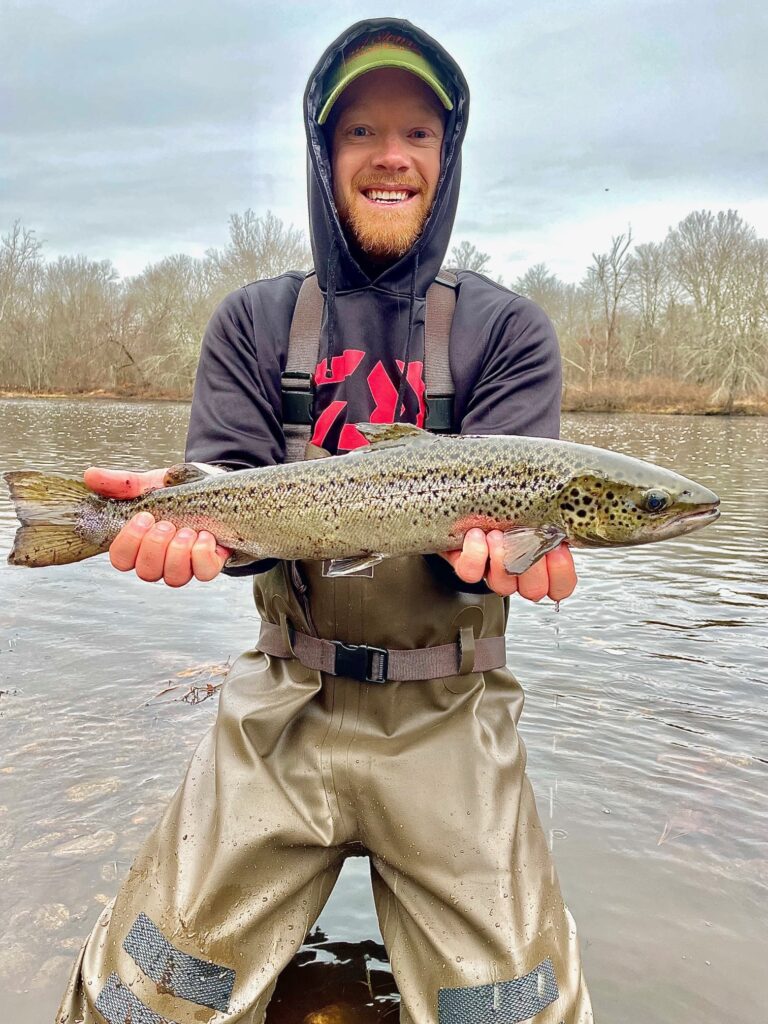
If it’s been a milder winter, or if you’re closer to the Long Island Sound shoreline, you are potentially going to have some open water to fish. If that’s the case, one of my favorite things to do is target trout and salmon with ultra-light tackle.
In terms of location, especially if you’re unfamiliar with targeting trout and salmon, your best bet is to look up the CT DEEP trout stocking program online. They’ll have a list of recently stocked lakes and rivers there, along with the species that were stocked. I am not a fan of chasing down the stocking truck and beating up a bunch of trout that just got dumped into the water hours before. To me, that takes the sport out of it. However, checking the stocking reports does give you a starting point, particularly if you’re going to fish a lake, where the fish can and do spread out more quickly than they do in smaller rivers. There are dozens of stocked trout lakes around the state and in nearby states that are fun to explore. One of my favorite things to do is choose a stocked lake that I’ve never been to and go on an adventure to it to see if I can get ahold of anything. It’s always fun to see a new spot, and catching a fish from a brand-new spot is always satisfying.
For gear, I like to use a 7’ medium or medium-light rod and a 2500 or 3000 size reel. My line is 10lb braid with a long leader of 6 lb. monofilament, or even just fully spooled with mono to protect against freezing. You don’t need to spend a lot on a trout setup if you’re just using it for fun in the winter, so don’t feel the need to go crazy with gearing up.
In terms of lures, my favorite for casting from the shore is an inline spinner. Rooster Tails, Panther Martins, Blue Fox, and Mepps are the most common that you’ll see in your local shops. The goal with these is to be able to cast them far but retrieve them slowly so that they can sink a bit while still being worked effectively. It’s not a one-size-fits-all situation in terms of the color or weight spinner you choose, and the proper spinner can vary greatly depending on where you are, as well as the current water levels. One thing I would highly advise against is buying the cheap bulk pack spinners you’ll find online. While the price is enticing and the baits look simple, any experienced angler will tell you that there is a huge difference between the known and respected spinner brands and the knock-offs, many of which won’t even spin unless they’re ripped through the water, making them completely useless. My advice is to go to your local tackle shop and stock up on 8-10 spinners. That may seem like a lot, but you will lose them to rocks and snags, so having backups is always crucial.
Once you’re at your local spot, you’ll want to start breaking down the water. Look for rising fish, indicated by small ripples on the surface caused by a trout’s head breaking the water. I also look for vegetation or dying vegetation that I can cast over the top of or near. Often in bigger lakes, I find trout hanging by veggies. A good rule of thumb to follow this time of year is that 90% of the fish are going to be in 10% of the water, a statement that I find particularly true in lakes. Trout will sometimes school up and sit tight, especially if the water temp stays consistent, and once you locate them, you can often come back days later and find them in the same spot.
If you can get out on an open water lake in the winter, it can be pretty magical. My favorite tradition is to fish my local lake during a snowstorm, when the water is glassy calm and the snow is falling. It can be pretty unreal out there. I’ll usually take my kayak and troll some spinners or shallow-running Rapalas in 8-12’ of water. That’s by far my favorite tactic, since once you locate the fish, you can catch quite a few if they’re in the mood.
If you’re doing any of the above tactics, you’ll also likely catch some pickerel, pike if they’re present, or maybe even some red-lipped cold water largemouth bass. In rivers, you’re more likely to only find trout, but other species are certainly not unheard of.
In the same vein, breaking down a river or creek for trout can be tougher than a lake in some spots and easier than a lake in others. If you are fishing in a river, your best bet is to look for some depth. Often, bridges and the areas near them are a great starting point. Look for deeper, slow-moving water or the edges of faster-moving water. Try to slice and dice that river with your spinner, covering a lot of ground with a bunch of casts. Retrieve your spinner with the current or somewhat perpendicular, but never against the current, which looks unnatural to the trout. I often try to retrieve my spinner as slowly as possible without getting hung up on the bottom, so that there’s ample time for the trout to see it and attack. This is where spending the money on a good spinner matters, as the nice ones will spin even when retrieved slowly.
Have some fun with cold water trout fishing. For me, catching a stocked trout doesn’t exactly cause my adrenaline to pump, but it does feel good to bend the rod and to be out in nature in an otherwise cold and dark time of year. It’s a great way to explore new parts of your home state and to practice breaking down new water, a skill that can pay big dividends in all types of water.
Ice Fishing
I am embarrassed to say that despite growing up in central Vermont, I had never been ice fishing until I was 35 years old. I’m not sure how it happened, but I do love ice fishing now when the opportunity presents itself. It’s a cool way to spend time with friends and catch fish in a unique way.
I admittedly do not know much about ice fishing, but I’ll share the basics that I do know. The best way to cover ground is to set up some tip-ups (available at local tackle shops) with live minnows on a small hook under a small split shot sinker. You’ll need a depth clip, an ice augur, and safety gear, which at minimum should be picks that you wear around your neck 100% of the time. I also use a sled to pack my gear in and pull it across the ice.
Set your tip-ups at varying depths with a good bit of distance between them. Once you start to get some action, you can adjust your slower tip-ups into more action-packed zones. While waiting for a tip-up flag to raise from a bite, jig a small spoon on an ultra-light ice fishing rod, a fun way to stay busy while you wait for action.
There’s way more information available online about ice fishing than I can provide here, but I’d say, at least from a newcomer, that ice fishing is worth it. Get warm winter clothing, 3-5 tip-ups, a jigging rod, and have some fun with it!